Kids ages 7 to 14 spend five days in Glendale writing, acting, filming, and editing a real short film, then premiere it for families Friday. No experience needed. Gear included.

You know that moment when your kid finishes a movie and starts explaining how they’d have done it better? Most parents in Los Angeles have lived that. The kid isn’t just watching anymore. They’re building something in their head.
So the question becomes simple. Where does that go next?
Glendale is a good answer. It sits right next to the studios that built this town. And a real film camp here doesn’t hand kids a tablet and call it a day. It hands them a camera, a script, a crew, and a deadline.
This guide walks through exactly what kids learn at a Glendale film camp. Skills, schedule, safety, cost, premiere day, all of it. No fluff, no vague promises, just what actually happens between 9 and 4.
A film camp in Glendale is a day program where kids ages 7 to 14 make a real short film from scratch. They write it. They act in it. They shoot it. They edit it. Then families watch it on a screen at the end of the week.
That’s the whole shape of it. In LA we say the proof is in the pudding, and here the pudding is a finished film with your kid’s name on it.
It is not a movie-watching club. It is not a coding class with a camera bolted on. And it is not screen time dressed up in a nice logo.
Glendale matters for a reason. The city sits minutes from Burbank, Hollywood, and Los Feliz. Kids working here are working in the same neighborhood as working crews. That’s not marketing. That’s just the map.
Camp runs Monday through Friday, 9:00 AM to 4:00 PM. Drop-off, work, lunch, more work, pickup. Five days. One finished film.
Parents comparing options usually ask one thing first. Does my kid need experience? No. Not a single day of it. The camp is built for beginners and still gives experienced kids room to run.
Here’s what the rest of this guide covers. Every skill, in order, the way kids learn it.
Kids learn to turn a loose idea into a script other people can shoot. That’s the first job, and honestly it’s the hardest one.
Most kids arrive with a big idea. A shark in a mall. A robot who forgets things. A kid who finds a door in the school gym. Great starts, all of them. But an idea isn’t a story yet.
So instructors teach structure in plain terms. What does your character want? What’s in the way? What happens when they fail?
Kids learn the working parts of a script:
Then comes the part nobody warns them about. Cutting. A ten-minute idea has to become a two-minute film. Kids learn to kill their favorite line because it slows the story down.
That stings. It also teaches something school rarely does. Writing is rewriting.
By day two, most groups have a locked script. It’s messy. It’s theirs. And every page has to survive contact with a real camera, which changes everything.
Kids who love this part often keep writing after camp ends. A notebook of half-finished scripts is a very good sign.
Kids learn that film acting is small. Stage acting is big. Those are two different muscles.
On a stage you play to the back row. On camera the lens is two feet away. A raised eyebrow reads. A shouted line does not.
That flip surprises kids fast. And watching it land is one of the better moments of the week.
What campers actually practice:
Shy kids do fine here. Better than fine, usually. A quiet kid often reads beautifully on camera because they aren’t pushing.
And if your child hates being on camera? They can crew. Camera, sound, script supervisor, director. Nobody is dragged in front of a lens.
Ever notice how kids drop the performance when a friend makes them laugh? Instructors chase that. Real beats real.
There’s a local saying about all of this. Fake it till you make it doesn’t work on camera. The lens catches everything.
Kids learn to lead a group of people toward one clear picture. Directing at camp is less about art and more about decisions.
Every camper takes a turn in the chair. That’s on purpose. A director calls the shots, sets the tone, and answers questions all day.
A camp director learns to:
That last one is the real lesson. Plans fall apart. Batteries die. An actor forgets a line eleven times. The clock keeps going.
Kids who never get to lead anything at school suddenly have eight people waiting on them. It’s a lot. It also builds something you can see in their posture by Friday.
Think of a director as the person holding the map on a hike. They don’t carry every bag. They just make sure nobody wanders off the trail.
Parents notice this skill more than any other after camp. It shows up at dinner, in group projects, in how a kid asks for what they want.
Kids learn that where you put the camera changes what the story means. Same actor, same line, different angle, different feeling.
This is the section kids get obsessed with. Give a ten-year-old a tripod and a wide lens and watch what happens.
Camera skills covered at camp:
They also learn shot lists. Before you roll, you write down every shot you need. Sounds boring. Saves the whole day.
And coverage. You shoot the same moment from a few angles so the edit has options. Kids who skip coverage learn the hard way in the edit bay. That lesson only needs to happen once.
Here’s a question worth sitting with. Why does a close-up feel more honest than a wide shot? Kids figure that out by testing it, not by being told.
By midweek, campers stop asking where the camera goes. They start arguing about it. That’s the win.
Kids learn that bad sound kills a film faster than bad picture. Every professional knows it. Almost no beginner believes it until they hear it.
So camp makes them hear it. Record a scene with the mic across the room. Then record it right. Play both back. The room goes quiet.
Sound work at camp includes:
Lighting gets the same treatment. Kids learn a key light, a fill, and a backlight. Three lights, endless moods.
They test it directly. Light a face from below and it turns creepy. Light it from the side and it turns serious. Same kid, same shirt, whole new character.
Glendale summer light matters too. Sun moves. A shot filmed at 10:00 AM won’t match the same shot at 2:00 PM. Kids learn continuity by getting burned by it once.
An old crew line fits here. Light is free until it isn’t. Then it’s the most expensive thing on set.
Kids learn how a background gets replaced and why the green matters. This is the day everybody talks about at pickup.
The technical name is chroma key, and it’s the same process used in weather broadcasts and big-budget features. A flat color gets keyed out in editing. Anything can go behind it.
What campers learn on green screen day:
That last point separates a good effect from a goofy one. If the background is a sunset and the actor is lit like an office, the brain rejects it instantly.
Practical effects show up too. Fake wind from a fan. A flashlight for lightning. A doorway framed to hide the whole rest of the room.
Kids realize movie magic is mostly cardboard, tape, and confidence. That doesn’t ruin it for them. It makes them feel let in on the secret.
And once a kid keys their first shot and sees themselves floating in space, something clicks. The screen stops being a thing you watch. It becomes a thing you build.
Kids learn that a film gets made three times. Once when it’s written, once when it’s shot, once when it’s cut.
Editing is where the week’s work becomes a movie. It’s also where kids discover they’re missing a shot they swore they got.
Editing skills taught at camp:
Software is age-appropriate and hands-on. Younger campers get simpler tools. Older campers push further.
The pacing lesson is the big one. Kids hold shots too long because they love them. Then they watch it back with fresh eyes and cut two seconds. The scene wakes up.
Parents often ask whether this sticks after camp. It does, more than most skills. Editing is the one campers keep doing at home on a phone.
If your child is drawn mostly to this side of things, that interest usually outlasts the week by a mile.
Kids learn to work with people who disagree with them. There is no version of filmmaking where you get to skip that.
A film set is a small society. Everyone has a job. If one person drops theirs, the whole day stalls.
Soft skills campers build without being lectured:
Wednesday is real, by the way. Ask any camp director. Energy dips, scripts feel dumb, and somebody gets frustrated.
Then Thursday happens. The footage starts cutting together. The film looks like a film. Everything turns around.
That dip and recovery is half the value of the week. Kids learn that hard middles are normal, not proof they picked wrong.
A metaphor worth borrowing: a film crew is a rowing team. Nobody wins by rowing harder alone.
You can read more about the wider set of skills kids learn at film camp if you want the full picture beyond the technical side.
Camp runs Monday to Friday, 9:00 AM to 4:00 PM. Here’s the honest rhythm of a day, not a brochure version.
Morning, 9:00 to 12:00
Drop-off, then a short warm-up. Groups review yesterday’s work. Then they get into the day’s focus, whether that’s writing, blocking, or shooting.
Mornings are for the heavy lifting. Kids are sharp, the light is workable, and attention is at its best.
Lunch and break, 12:00 to 1:00
Kids eat, run around, and talk about their films nonstop. Bring a packed lunch and a refillable water bottle. Glendale summers get hot and dry.
Afternoon, 1:00 to 4:00
Production continues. Later in the week, afternoons shift toward editing and finishing.
Then pickup at 4:00, usually with a kid who wants to explain the entire plot on the drive home.
By day:
Every group runs a little different. Some finish shooting early. Some are still grabbing a shot Thursday afternoon.
Want the longer version of this? The film camp curriculum week by week breakdown lays out each day in more detail.
Camp serves ages 7 to 14, and kids are grouped by age and readiness. A seven-year-old and a fourteen-year-old don’t work the same way, and pretending otherwise helps nobody.
Younger campers get shorter scripts, more structure, and heavier instructor support. Their films run short and sweet.
Older campers get more independence. Longer scripts, more complex shots, deeper editing work. Some arrive with real skills already.
What stays the same at every age:
That last point matters more than parents expect. Finishing is the lesson.
Is your kid the youngest in the room? That’s usually fine. Groups are small and instructors know how to pull a quiet seven-year-old in without spotlighting them.
Is your teen worried about being stuck with little kids? Also fine. Age grouping handles it.
No experience is required at any age. Kids who’ve never held a camera and kids who’ve made twenty YouTube videos both leave with something new.
Friday ends with a premiere. Families come in, lights go down, and the films play on a big screen.
It’s not a slideshow of camp photos. It’s the actual short films, with titles, credits, sound, and everything the kids built.
Here’s what usually happens:
Kids get nervous right before. Then their title card comes up and the room claps. Then they spend the next two minutes watching the audience instead of the screen.
Parents cry more than they expect to. That’s not a sales line. It’s just what happens when you watch your kid’s name in a credit roll.
After the screening, kids explain their choices. Why that angle. Why that ending. Why the ghost was actually the sister the whole time.
Families receive a copy of the film so it doesn’t live only on a camp drive. Kids send it to grandparents. They rewatch it in October.
If you want to see the kind of work that comes out of a week, ask to watch past student films before you enroll.
Premiere day is also the clearest answer to the value question. You’re not buying childcare. You’re buying a finished thing your kid made.
Kids are supervised by background-checked staff for the entire day. That’s the baseline, not a bonus feature.
Parents ask about this and they should. It’s the first question that matters and the one camps often bury on page four.
What responsible safety looks like at a Glendale film camp:
Then there’s media consent, which is specific to filmmaking. Your child appears on camera. Their face ends up in a film.
You control where that film goes. Parents sign a media consent form that spells out whether the footage can be shown publicly, used on a website, or kept private to families.
If you decline public use, your child still participates fully. They still act, still crew, still premiere. The film just doesn’t go online.
Ask any camp how they handle this before you pay. A camp that can’t answer clearly is telling you something.
Guidelines from the American Camp Association are a useful yardstick for staff screening and supervision ratios if you want an outside reference point.
A week of specialty day camp in Los Angeles typically runs a few hundred dollars, and film camp sits in that specialty range. Equipment, small groups, and skilled instructors cost more than a field and a whistle.
Fair enough. But price alone tells you nothing. What matters is what the number includes.
Ask every camp these questions before you pay:
Cheap camps often make their margin on the add-ons. You book at one price and pay a different one by Friday.
Film Camp lists one price per week and includes the gear, the instruction, the premiere, and the film file. No surprise line items in July.
Money is tight for a lot of families and pretending otherwise is silly. Ask about payment plans and scholarships directly. Most good camps have something, and the ones that do rarely advertise it loudly.
For a wider view on what drives camp pricing, the piece on hidden fees parents miss when booking camps is worth ten minutes.
Ready to check dates? You can see current Glendale session dates and enroll in a few minutes. Spots for popular weeks go early, so booking sooner beats scrambling in June.
You judge a film camp by what kids walk out with. Everything else is decoration.
LA has a lot of camps. Some are excellent. Some are a laptop, a folding table, and a hopeful website.
Green flags to look for:
Red flags worth walking away from:
Here’s the sharpest test. Ask what your child will hold on Friday afternoon. A good camp answers in one sentence.
In this town everybody talks a big game before lunch. Ask for the reel instead.
You can also look at how the camp handles the boring stuff. Cancellation policy, pickup rules, communication before the week starts. Boring stuff done well predicts a good week.
Film Camp’s Los Angeles location runs at Solar Studios, 3909 San Fernando Rd, Glendale, CA 91204. It’s a working studio space, not a repurposed classroom.
Every Glendale week is listed on the page for our summer camps in Los Angeles, with dates and times in one place.
That address sits near the Glendale and Atwater Village line, close to the 5 and the 134. Families come in from Burbank, Los Feliz, Eagle Rock, Silver Lake, Pasadena, and the east Valley without much drama.
Practical details parents actually need:
Anyone who drives the 134 at 8:40 AM knows the deal. Leave earlier than feels necessary. LA traffic doesn’t care about your plans.
Questions before the week starts? Call or email and ask anything, including the awkward ones about your child’s specific needs.
The studio setting is part of the point. Kids walk into a space that feels like work, not like school in July. That shift alone changes how they show up.
Kids come home with a finished short film and a different relationship to screens. Those are the two big ones.
But the smaller changes are the ones parents mention months later.
Concrete takeaways:
The quieter takeaways:
Your kid stops watching movies passively. They start noticing camera moves and edits. They pause things to explain a choice.
They also learn that finishing is a skill. Lots of kids start projects. Fewer finish them. A week with a hard Friday deadline changes that math.
And for a shy kid, there’s the thing that’s hard to name. They spent a week being needed by a group. That sits differently than being told they’re capable.
Not every kid becomes a filmmaker. Most won’t. But storytelling, planning, teamwork, and finishing hard things travel everywhere.
Film camp gives kids one finished project. Most summer programs give kids a schedule. That’s the core difference.
Los Angeles parents have plenty of choices in July. Sports clinics, coding camps, general day camps, art programs, summer school. All of them can be good. They just do different jobs.
General day camp keeps kids busy and social. Great for energy, light on skill building. Your child comes home tired and happy with no product to show.
Sports camp builds one clear physical skill. Wonderful for a kid who loves the sport. Rough for a kid who doesn’t.
Coding camp builds technical skill and often ends with a project. Closest cousin to film camp, honestly. The difference is that film work pulls in writing, speaking, and performing too.
Summer school fixes a gap in a subject. Useful. Rarely something a kid looks forward to.
Online filmmaking courses teach real information at a lower price. But a kid alone at a laptop doesn’t get a crew, a set, or a deadline anyone else cares about. Most online courses get abandoned by week two.
So which fits your child? Ask what they’re missing, not what looks impressive.
Film camp is the strongest fit when a kid:
Around here, people say you can’t judge a taco by the truck. Same with camps. The label matters less than what comes out the window.
The most common mistake is booking on price alone. The second is booking too late. Both are fixable.
Cheap camps aren’t automatically bad. But specialty filmmaking needs gear, small groups, and instructors who’ve worked on sets. Those things cost money. If a price looks impossibly low, ask what got cut.
Other mistakes worth dodging:
There’s also the overscheduling trap. A kid stacked into eight straight weeks of programs arrives at film camp already fried.
One strong week beats a blurry summer. Give them room to breathe on either side of it.
And ask your child directly. Not “do you want to go to camp,” which gets a shrug. Try “do you want to make a movie with a crew in five days.” Watch what their face does.
Does my child need filmmaking experience?
No. Film Camp is built for beginners. Kids who’ve never touched a camera start on day one alongside kids who’ve made videos before. Groups are structured so both get something out of the week.
What ages is the Glendale camp for?
Ages 7 to 14. Campers are grouped by age and readiness so the work matches where they are.
What are the camp hours?
Monday through Friday, 9:00 AM to 4:00 PM during scheduled sessions.
Do kids need to bring their own camera or laptop?
No. Equipment is provided. Kids bring lunch, water, and comfortable shoes.
Will my shy child be okay?
Usually yes. Quiet kids often thrive because film work has many roles. A camper who doesn’t want to act can run camera, sound, or direct. Nobody is forced in front of a lens.
Does every camper get a finished film?
Yes. Every camper leaves with a finished short film that screens at the Friday premiere, and families get a copy.
Is the Friday premiere open to family?
Yes. Families are invited to watch the films on a screen at the end of the week.
Who supervises the kids?
Background-checked instructors and staff supervise campers for the full day, with small group sizes.
What happens if my child appears on camera and I don’t want the film shared publicly?
You control that through the media consent form. Your child still participates fully. The film simply isn’t published.
Is this just screen time in disguise?
No. Most of the week is talking, planning, acting, moving, and shooting. Editing is one part of the process, not the whole thing.
How far in advance should we book?
Earlier is safer. Popular Glendale weeks fill first, and summer scheduling tightens fast in Los Angeles.
What if we need to cancel?
Check the published cancellation policy before you enroll so you know the refund window in writing.
Here’s the honest summary. Your child spends five days writing, acting, shooting, and editing a real short film. They work with background-checked instructors in a Glendale studio. Friday night, families watch the result on a screen.
No experience needed. Gear included. One clear price with no surprise fees.
That’s the whole offer, plainly stated.
If you’re still comparing camps, good. Compare hard. Ask about class size, staff screening, and what your kid holds on Friday. Any camp worth your money answers those without flinching.
And when you’re ready, see summer dates and enroll for the Glendale sessions. It takes a few minutes.
Summer moves fast in this town. The kid who’s been storyboarding on napkins all spring deserves a real set to try it on.
.jpg)
Discover how kids ages 7–14 learn screenwriting, acting, directing, camera work, editing, teamwork, and confidence at Los Angeles Film Camp in Glendale while creating and premiering their own short film.
Read >
Young filmmakers gain professional movie-making skills through hands-on projects, learning storytelling, directing, camera work, sound, editing, teamwork, safety, feedback, role rotation, and confidence while completing and premiering their own films.
Read >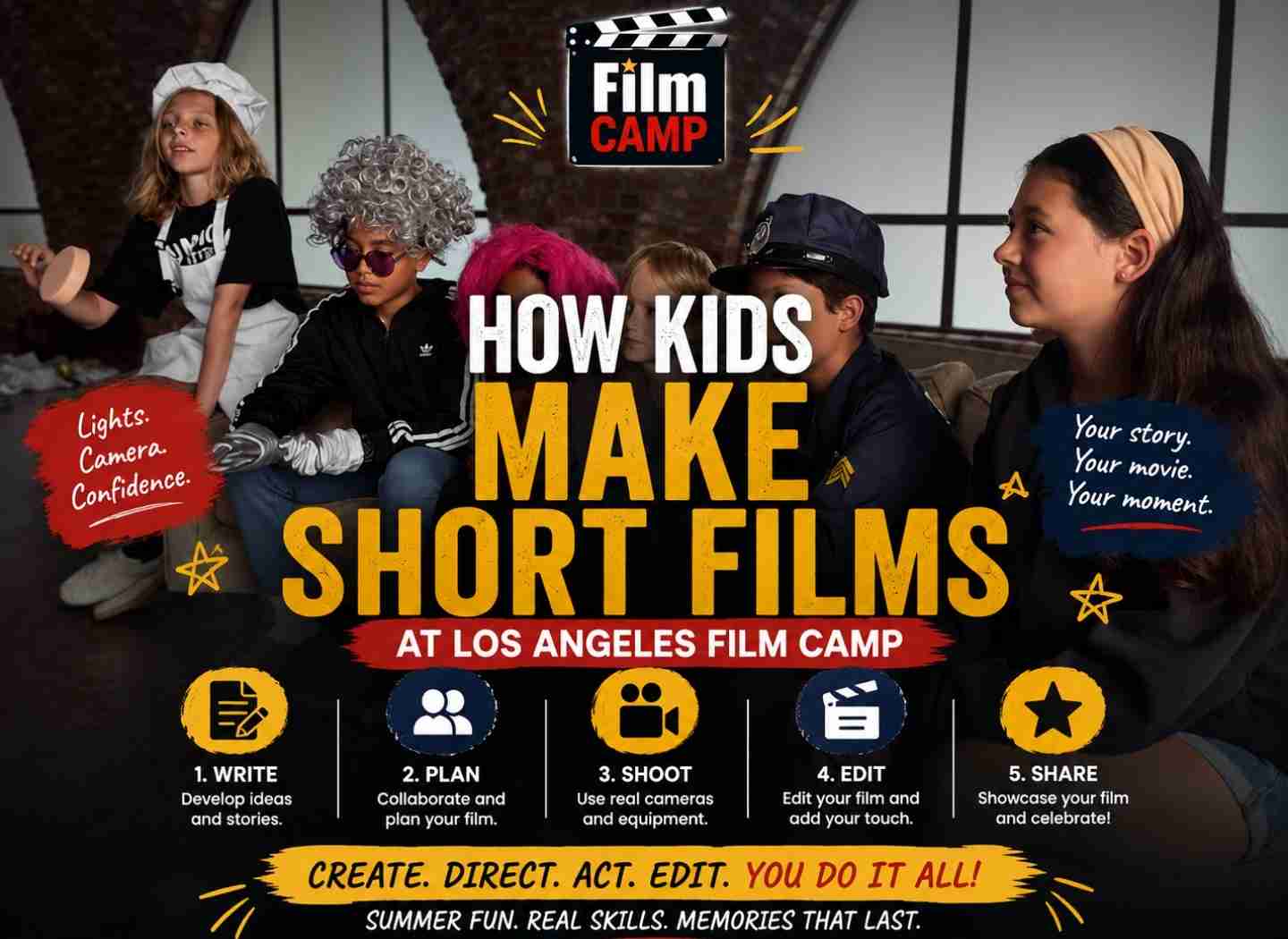
Kids write, shoot, and edit their own short films in one week at Los Angeles Film Camp. Hands-on, safe, and no experience needed. See how it works, from first idea to premiere.
Read >Kids ages 7 to 14 spend five days in Glendale writing, acting, filming, and editing a real short film, then premiere it for families Friday. No experience needed. Gear included.
Read >.png)