Summer camps offer intense, transformative growth through immersion; after-school activities build steady skills through repetition. Ideally, combine both — camp in summer, activities during the school year!

Picking between summer camp and after-school activities feels like picking between pancakes and waffles. Both sound great. Both fill a need. But they hit different.
Every parent asks the same thing. Where will my kid grow the most? Where will they have real fun? And honestly, where is my money going the furthest?
Let's break it down the way a friend would. No fluff. No sales pitch. Just the real stuff.
There's an old saying: "A child grows where a child is planted." Where you plant them matters. A gym mat, a film set, a chess club, a lake, a theater stage. Each soil grows a different root.
So which soil wins? Let's dig in.
Summer camp is a full-immersion experience. Kids go deep into one thing. Or many things. For a week. Or two. Or a whole summer.
Think of it like a crash course in becoming someone new. No school bell. No backpack. No homework cloud floating above their head.
Kids eat, play, learn, and create in the same space. Some camps are day camps. Some are overnight. Some focus on one skill like filmmaking, coding, or soccer.
The vibe is different from school. It's not a class. It's a tribe for the week.
Common summer camp types include:
Summer camps squeeze a lot of growth into a short window. That's their magic.
After-school activities are the steady drip. They happen once or twice a week. Every week. All year.
Your kid finishes school, grabs a snack, and heads to soccer, piano, or robotics club. It's part of the weekly rhythm. Like brushing teeth.
The goal here is consistency over intensity. Small bits of skill-building stacked over months. Sometimes years.
Popular after-school activities include:
These programs fit into your family's normal week. They don't disrupt vacation plans. They don't ask for a suitcase.
But can a once-a-week class compete with a full-week camp? That's the real question.
Here's where it gets real. These two look similar on paper. In practice, they're worlds apart.
Time intensity. Summer camp is full days. Often full weeks. After-school is one to three hours, a few times a week.
Skill curve. Camp speeds up learning. Kids get better fast because they practice all day. After-school builds slow muscle memory.
Social depth. Camp friendships feel intense. Kids bond hard over shared experiences. After-school friendships are slower burns but often longer-lasting.
Freedom from routine. Camp pulls kids out of their normal life. After-school plugs into it.
Cost structure. Camps charge a lump sum. After-school spreads payment over months.
Think of it this way. After-school activities are a marathon. Summer camp is a sprint with fireworks.
Both have value. They just serve different goals.
Honest answer? Both. But in different ways.
Summer camps build confidence through full immersion. Kids face new challenges without parents nearby. They solve problems on their own. They make friends from scratch in 48 hours.
That's a life skill textbook can't teach.
After-school activities build discipline through repetition. Showing up every Tuesday at 4 PM for piano teaches patience. Missing practice teaches consequences. Slowly leveling up teaches grit.
Here's the cool thing. A kid who does both gets the best of both worlds.
They learn the slow art of mastery from weekly classes. Then they get hit with the fast-burn growth of camp. That combo is powerful.
Research from the American Camp Association found that 96% of campers reported making new friends. Around 70% said camp helped them gain confidence. That's not just a fun week. That's development.
Most parents worry about the summer slide. That's the drop in academic skills during summer break. It's real.
Studies show kids can lose up to two months of math skills over summer. Reading can slip too. Especially in lower-income households.
After-school tutoring or academic clubs can help during the school year. They reinforce what kids learn in class. That's solid.
But summer camps, especially academic or skill-based ones, can flip the summer slide into a summer leap. Kids come back sharper. More focused. More curious.
Specialty camps like film, coding, or science go even deeper. A kid spending five days on storytelling or algorithms gains more than a semester of after-school club time.
Why? Because depth beats duration when it comes to skill-building. A week of focused practice often outperforms a year of once-a-week drop-ins.
This is where the debate gets interesting.
After-school activities give kids a stable social crew. Same faces every week. Same jokes. Same routines. It's comfortable. Predictable. Safe.
Summer camp throws kids into a brand new social pool. They have to introduce themselves. Make friends fast. Work with strangers.
That's uncomfortable. And that discomfort is exactly what builds social muscle.
Ever notice how kids come home from camp different? They stand taller. Talk more. Share more stories at dinner.
That's the camp effect. They just spent a week being the main character of their own movie.
After-school clubs don't usually create that shift. They build steady friendships. They don't rewrite a kid's social identity.
Neither is better. They're just different tools for different jobs.
Let's talk money. Because this matters.
After-school activities usually cost between $50 and $300 per month. Over a year, you might spend $600 to $3,600 per activity. Add multiple activities and it climbs fast.
Summer camps range wildly. Day camps can be $200 to $800 per week. Overnight camps run $1,500 to $3,000 per week. Specialty camps like film or coding sit in the middle to upper range.
So which gives you more bang for your buck?
Here's my take. If your kid is passionate about one thing, a specialty camp often delivers more growth per dollar. A week at film camp can spark a lifelong interest. That's a big return.
If your kid is still exploring, after-school variety might serve them better. They can sample soccer, piano, and robotics without a huge commitment.
Also worth noting: many camps offer scholarships. Most after-school programs don't. That's a small but real financial edge for camp families.
This one's big. And it gets overlooked.
Summer camp creates what psychologists call "productive discomfort." Kids are away from home. Away from phones. Away from familiar adults.
They have to regulate their own emotions. Handle homesickness. Work out conflicts without a parent stepping in.
That builds emotional resilience. Fast.
After-school activities don't push that button the same way. Parents are usually nearby. Routines are comfortable. Kids don't have to stretch.
Is that bad? No. Comfort has its place. But growth happens at the edge of comfort.
A child who spends a week navigating camp life learns:
These aren't small wins. They're life skills that compound over years.
After-school programs give kids emotional steadiness. Summer camps give them emotional stretch. Both matter.
Let's talk specifics for a second. Because not all camps are created equal.
A traditional camp gives kids a taste of everything. Swimming, crafts, hiking, sports. That's great for building broad experience.
A specialty camp goes deep. Really deep. Kids walk away with a skill, a portfolio, or a finished project.
Film camps are a great example. Kids learn the full filmmaking process. Writing. Directing. Editing. Acting. They leave with an actual short film they made.
That's not just a fun week. That's a tangible achievement. Something they can show family. Something they can put on a college application. Something that builds real confidence.
Why does this matter? Because kids today are bombarded with short-form content. TikTok. Instagram Reels. YouTube Shorts. They consume it all day.
Giving them the skills to create instead of just scroll flips the script. They move from audience to author.
At Film Camp, kids in Austin spend their summer learning how real films get made. They work with cameras, scripts, and editing software. They leave with a story they can actually watch on a screen.
That's a different kind of growth than a weekly art class. Neither is better. Just different.
Still torn? Use this simple framework.
Ask yourself four questions:
1. What does my kid already have in their life? If they have tons of structured activities during the school year, summer camp adds variety. If they have mostly free time, after-school activities add steady structure.
2. What are they missing? Are they craving new friends? Go for camp. Are they craving skill mastery? Weekly classes might help. Do they need confidence? Camp. Do they need routine? After-school.
3. What can I realistically afford? Budget honestly. Then match the program to your budget. Don't stretch for a fancy camp if it stresses the family.
4. What does my kid actually want? Ask them. Seriously. A kid forced into an activity rarely thrives. A kid who picked the activity usually does.
Once you answer these, the choice gets clearer.
Some families do both. After-school during the year, summer camp in the summer. That's the full combo meal. And it often produces the most growth.
Not every program is a good program. Keep your eyes open.
Red flags in summer camps:
Red flags in after-school activities:
Ever noticed how the best programs are also the most transparent? That's not a coincidence.
Good programs want you to ask questions. They show you around. They tell you exactly what your kid will do each day.
If a program dodges your questions, that's your answer.
Want the real scoop? Listen to the kids.
Kids who attend summer camp often say things like:
Kids who attend after-school activities often say:
See the difference? Camp kids talk about transformation. After-school kids talk about progression.
Both are valuable. But if your kid needs a shake-up, camp delivers. If your kid needs steady growth, after-school wins.
Can a kid do both in the same year?
Absolutely. That's actually the ideal setup for many families. Weekly activities during the school year. Camp in the summer. Balanced growth across all twelve months.
What age is best to start summer camp?
Day camps work for kids as young as 4 or 5. Overnight camps usually start at age 7 or 8. Specialty camps often accept kids from age 8 and up. Always check the specific camp's age range.
Are overnight camps safe?
Reputable overnight camps are very safe. Look for American Camp Association accreditation. Check staff training. Read reviews. Ask about emergency procedures. Safety-first camps are proud to share their protocols.
How do I handle a kid who resists camp?
Start small. Try a day camp first. Or a short three-day specialty camp. Let them build confidence gradually. Don't force a full week overnight if they're not ready.
What if my kid hates the activity I picked?
Happens all the time. Let them try it for a set period. If they still hate it, pivot. Forcing kids into activities they despise teaches them to hide their feelings. That's not the goal.
Here's something most articles skip. Summer camp isn't just about the kid.
It's about the family.
When your kid is at camp, the whole house shifts. Parents get breathing room. Siblings get one-on-one time. Family routines reset.
That space matters. Especially for burned-out parents juggling work, school pickups, and endless extracurriculars.
A week of camp can feel like a family reset button.
After-school activities don't give you that. They add to the schedule. They require driving, waiting, coordinating.
Camp takes the load off. For a week or two, you can breathe a little. That's a benefit worth naming.
Here's the big-picture question. What kind of adult are we building?
After-school activities often produce skilled specialists. Kids who stick with piano for ten years become excellent pianists. Kids who play soccer from age 5 to 18 become strong athletes.
Summer camps often produce adaptable generalists. Kids who attend different camps every summer become comfortable in new environments. They meet new people. They try new things. They fail and recover fast.
Neither is better. Both are valuable.
But in today's world, adaptability might just have the edge. The job market keeps shifting. Skills keep changing. Industries keep evolving.
A kid who learned to walk into a room of strangers and belong has a superpower. That's often a camp kid.
A kid who learned to stick with something hard for years also has a superpower. That's often an after-school kid.
The dream? Raise a kid with both.
The honest answer: neither. And both.
After-school activities build steady skill and routine. Summer camps build growth spurts and resilience. Kids need both kinds of input.
If you have to pick one, think about what your kid is missing most right now. Confidence? Go camp. Structure? Go after-school. A new tribe? Camp. Long-term skill? After-school.
And if your kid is into something specific like film, arts, or coding, a specialty camp can light a fire that lasts years. Sometimes one week changes everything.
That's the real power of summer programs. They don't just entertain. They reshape how a kid sees themselves.
At Film Camp, we've watched shy kids become directors in five days. We've seen quiet kids discover their voice behind a camera. We've watched friendships form that outlast the summer.
That's not magic. That's what happens when you plant a kid in the right soil.
If your kid loves stories, movies, or just making stuff with friends, summer might be the perfect time to try something new.
Film Camp in Austin, TX gives kids a full filmmaking experience. Writing, shooting, editing, and screening their own short films. No experience needed. Just curiosity.
Reach out to chat about summer programs.
Phone: (323) 471-5941 Email: hello@film.camp Address: 5900 Balcones Drive, Suite 100, Austin, TX 78731
Your kid's summer story could start here.

Los Angeles Film Camp's final summer session runs July 27–31 at Solar Studios in Glendale. Kids ages 7–14 write, shoot, act, and edit an original short film, then premiere Friday.
Read >
Kids ages 7 to 14 can register for Los Angeles Film Camp at Solar Studios in Glendale. This guide covers simple steps, session dates, pricing, safety, and premiere day.
Read >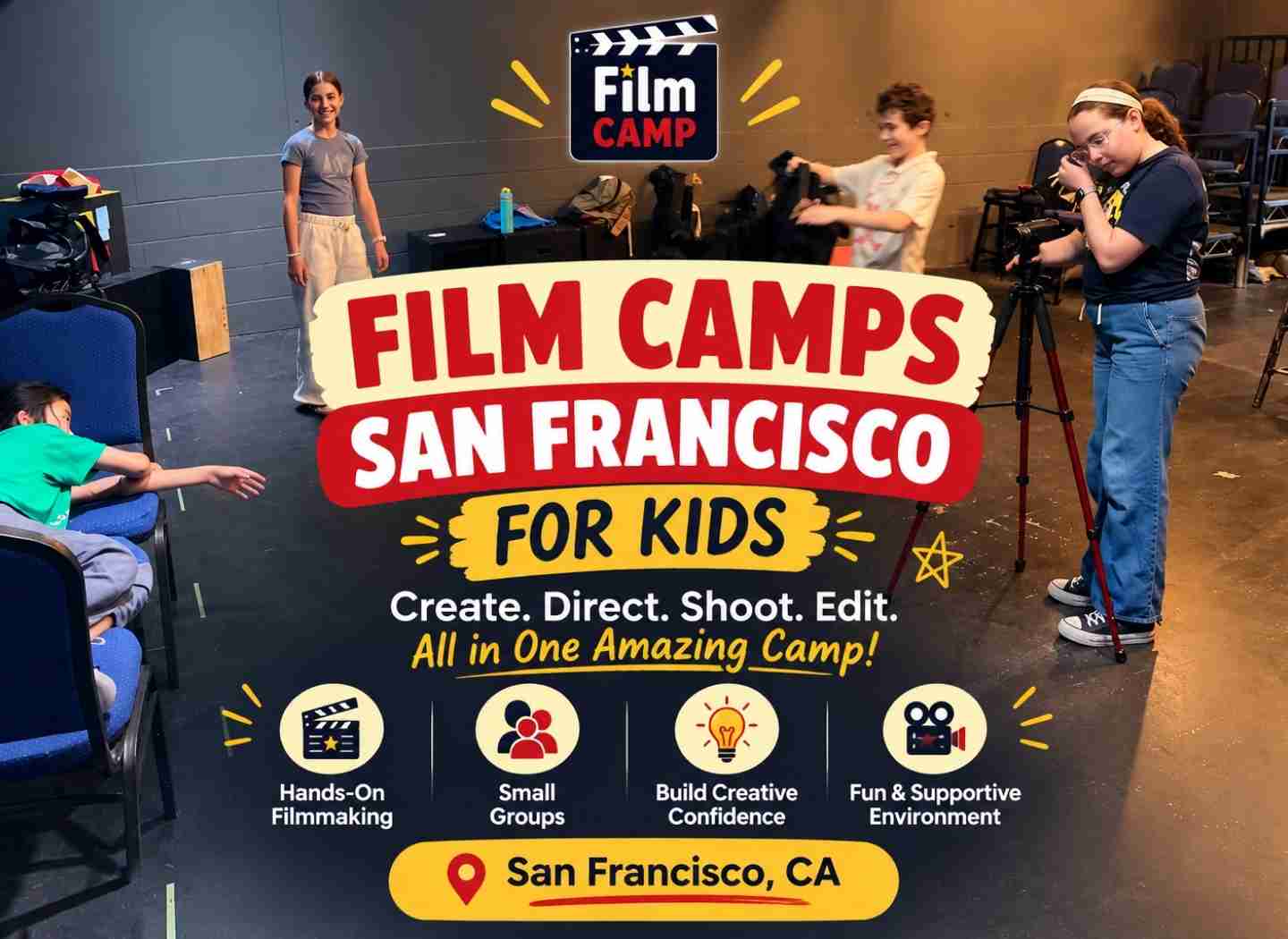
Comparing film camps in San Francisco? This guide shows five signs of a great one, what fair pricing looks like, how safety works, and how to choose the right summer camp confidently.
Read >.jpg)
Break weeks leave working parents scrambling. A holiday film camp covers the workday while kids write, shoot, and edit a short film in five days, ending with a family premiere.
Read >.png)