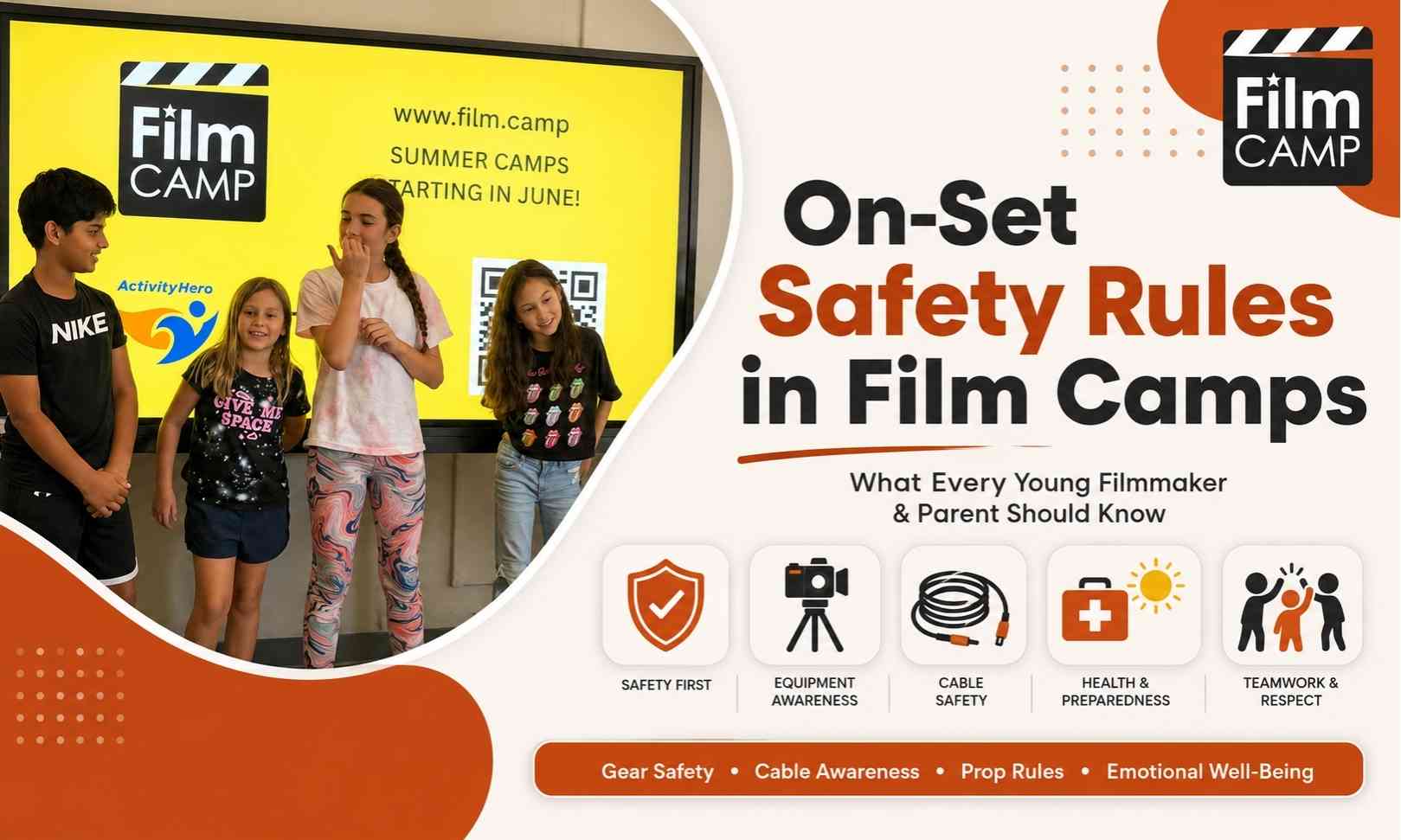
Keep young filmmakers safe on set with essential film camp rules: gear safety, cable awareness, prop guidelines, emotional well-being, sun protection, and teamwork—helping kids create confidently, responsibly, and professionally.
A film set looks like pure magic from the outside. Big lights. Bigger cameras. Kids running around with walkie-talkies, calling "rolling" like they've done it a hundred times.
But up close? A film set is more like a busy kitchen. Hot stuff. Sharp stuff. Lots of moving hands. One wrong step, and someone's on the floor.
That's the part most folks don't see at a film camp. The safety part. The rules that keep a summer Tuesday from turning into a trip to the urgent care.
We've been running a film camp Austin parents trust for a while now. Kids ages 7 to 14. Teens too. And honestly, before we hand a camera to anyone, we walk through the rules. Twice.
This post is the long version of that talk. Real on-set safety rules. The ones we use every single day at our summer film camp.
Whether your kid joins us in Texas, our film summer camp los angeles sessions, or our weekend clubs over in the Bay, the rules are the same. Safety first. Story second. Snacks somewhere in the middle.
Here's the truth most camps don't say out loud. A film set is a workplace. Even when the workers are 9 years old.
There's gear. There's electricity. There's stuff being lifted, dropped, rolled, and rigged. The pros call it a "controlled creative environment." We just call it "a place where stuff can go sideways fast."
Why does this matter for a film camp for teens in austin or a video production camp rrisd session? Because young filmmakers copy what they see. If the adults are casual about safety, the kids will be too.
Ever seen a tripod crash on a Saturday morning shoot? It's not pretty. The camera doesn't always survive. The toes underneath sometimes don't either.
In Texas we say, "all hat, no cattle." Means all talk, no action. On set, we flip that. Less talk about safety. More doing it.
Safety isn't the boring part of camp. It's the offensive line of filmmaking. Nobody claps for it. But the play falls apart without it.
Real film unions like SAG-AFTRA and groups like Cal/OSHA put out safety bulletins for the whole industry. We use the same ideas with our campers. Just in plain English. With more snacks.
When you walk onto our film camp soundstage in Austin, the first thing we say is this. Treat the set like a job. Not a stuffy office job. But a job. With rules.
That mindset flips a switch in young filmmakers. Suddenly, they stand a little taller. They listen better. They stop running.
Here's what "set is a workplace" actually means at our teen summer camps austin film programs:
We borrow this stuff straight from real Hollywood crews. Same gear talk. Same set lingo. Just softer voices and lower ceilings.
Our film kids austin instructors run a little gear check before each shoot. Shoes. Hair. Water. Phones. Five seconds. Done.
It feels small. But it adds up. By Friday, the campers are doing the gear check on each other without being asked. That's the goal.
A real set protects the workers. A camp set protects the kids. Same idea, smaller scale.
Set etiquette is the social side of safety. It's how a crew talks and moves so nobody gets hurt. Or annoyed. Or shouted over.
Most accidents on small sets aren't from explosions or stunts. They're from someone walking through a shot. Or grabbing a hot light. Or tripping on a cable they didn't see.
So we teach the basics on day one of every summer film camp session. The same way pros do it. Just kinder.
The five core set rules we drill at camp:
These five sound simple. But repeat them daily for a week, and they become second nature. That's the whole point.
We tell the kids it's like learning a new language. Set language. Once you get fluent, you'll feel like you've been doing this forever.
By Wednesday of camp week, we hear 8-year-olds calling "background" before they cross a shot. It's adorable. And it's exactly what we want.
Camera gear is heavy. Tripods are tippy. And kids are kids.
Our film camp uses real cameras. Not toys. Real DSLRs, mirrorless rigs, and sometimes higher-end stuff for our older film camp for teens in austin sessions. So the rules around them have to be real too.
Three big tripod rules we never break:
Cameras at our video production camp rrisd workshops live on neck straps too. Always. Even when a kid is just walking ten feet to the next shot.
Why? Because a $1,500 camera dropped on a concrete floor is a sad day for everyone. And honestly, it's the toes we worry about more than the camera.
For sliders, gimbals, and any kind of motion rig, we follow a simple rule. Two hands. Two eyes. Two adults near it. No solo experiments.
The same thinking applies to drones, when older campers use them. We never fly indoors. We never fly near faces. We never fly without an instructor right there.
Cinematography is a craft. Carrying gear is a skill. We teach both at the same time, on purpose.
If you ask any real grip what hurts people on set, they'll say the same thing. Cables. Lights. Heat.
You don't see them as risks until somebody trips. Or burns their hand. Or pops a breaker on day one of camp.
Cables on set are like vines in the jungle. One bad step, and someone's on the floor. So we tape them down. Every time. No shortcuts.
Our lighting and electrical rules for kids and teens:
We don't use big tungsten lights with our youngest film kids austin campers. We stick with LED panels. They're safer. They don't get blistering hot. They sip power instead of guzzling it.
For our film camp for teens in austin sessions, we'll bring out bigger fixtures. C-stands. Flags. Diffusion. But every time, we walk through the setup like a checklist.
Sandbags on every stand. Cables wrapped, not crossed. Outlets tested. Crew briefed.
It takes ten minutes. Saves the whole shoot day.
And one little rule that surprises parents? No drinks on the gear table. Ever. A water bottle tipping onto a $800 light is a fast way to end a session.
Now let's talk about the part that sounds dramatic but really shouldn't be. Props and stunts.
Hollywood has had hard lessons on this. Real ones. So our film camp plays it extremely safe. Always.
Our "No Real Anything" Rule is simple. No real weapons. No real fire. No real fights. No real food fights either, weirdly, since slippery floors stink.
If a script calls for a "sword," we use a foam stand-in. If it calls for a "punch," we shoot it with angles, sound, and reaction shots. No contact.
For young filmmakers, this isn't a downgrade. It's actually how the pros do it. Real movies you love use fake weapons, stage blood, and stunt doubles. The "magic" is in the edit, not the real swing.
Prop safety rules we teach kids and teens:
For our older teen summer camps austin film sessions, we sometimes write small action sequences. Falls. Chases. Stunt-style stuff.
The rule there? A coordinator (adult) blocks every move first. The teens then walk through it slowly. Then half speed. Then real speed. Only when everyone's confident, we roll camera.
Why all this caution? Because a movie set's job is to look dangerous, not be dangerous. Big difference.
A california film summer camp or a film camp glendale sister program might handle this with the same playbook. The industry standard is well-known. We just translate it for kids.
Sound is the underrated piece of film safety. Most people forget it even matters.
But think about it. If a young camper is wearing headphones, they can't hear the world around them. That's a safety issue. Especially on a busy set.
Sound rules at our summer film camp:
We also teach what "quiet on set" actually means. It's not just silence. It's everyone freezing, including hands. Crinkling a snack bag mid-take? That's a re-take. And probably some funny looks.
Our film camp austin sound instructors love this part. They get to explain why "real movies" sound so clean. The answer: the crew is disciplined. Quiet. Aware.
Once kids get it, they start policing each other. "Shhh, I hear AC." "Mute the phone." "Someone's chewing gum too loud." We've heard it all. It's gold.
For our film summer camp los angeles campers, we even bring in real production sound mixers as guest speakers. They tell stories about car alarms ruining takes. Or planes. Or a dog. Kids eat it up.
Sound safety is part hearing protection. Part awareness. Part respect for the work.
All three matter.
Now this one's important. And most camps skip it.
Safety isn't just bodies and bones. It's brains and feelings too.
A film set can be intense. Big personalities. Big ideas. Sometimes big disagreements about which scene goes where. Even kids' sets get that way.
So at our film camp, we set up mental and emotional safety from the start. Real rules. Real follow-through.
Our emotional safety rules:
Why does this matter so much? Because a camper who feels safe takes creative risks. A camper who feels unsafe shuts down.
We've seen kids walk in shy on Monday and direct a whole crew by Friday. That doesn't happen if the room feels tense.
For our film camp for teens in austin sessions, the emotional stakes go up. Teens care more. Crit hits harder. So we keep the feedback structured and kind. Always start with what worked. Then ask what could grow.
Our instructors are also trained to spot stress. The kid going quiet. The one who keeps "needing the bathroom." The one who suddenly doesn't want to be on camera.
We pull them aside. We chat. We adjust. No camper gets left in a hard moment alone.
This is also why our film kids austin ratios stay small. About 1 instructor per 6–8 kids. Smaller for younger campers. So nobody slips through.
A safe set is a kind set. Always has been. Always will be.
Let's be real about something. Texas in June is hot. Like, "your shoes melt to the parking lot" hot.
Our film camp austin location at 5900 Balcones Drive sits in a part of town where the sun shows up early. So sun safety is baked into our day.
Our summer heat and first-aid rules:
Sun-poisoning and heat exhaustion sneak up fast on kids. They get tired before they realize they're dehydrated. So we count water bottles, not arguments about water bottles.
For first aid, every Film Camp instructor carries a small kit. Bandages. Cold packs. Wipes. EpiPen if a parent has flagged an allergy.
Every parent fills out a health form during signup. No form, no shoot day. Allergies, asthma, meds, emergency contacts. We read these before camp starts. Not during a crisis.
Our staff is CPR-trained. Most are also first aid certified. We post the nearest urgent care address on the wall in every camp room. Just like a pro production posts the nearest hospital on a call sheet.
For our california film summer camp programs, the heat is a little different. But the rules don't change. Water. Shade. Sunscreen. Breaks.
If you're enrolling in a film camp glendale session, expect the same playbook. Standard kid-safety stuff. Just done with film-set rhythm.
The fastest way to ruin a great shoot? A heat-sick camper. We work hard to make sure that never happens.
We're not gonna pretend safety is fun on its own. It's not. But the way we teach it? Kids actually love it.
Day 1 at Film Camp looks like this:
That last one is a Film Camp favorite. The scavenger hunt turns safety into a game. Kids remember where stuff is for the rest of the week.
By Day 2, the campers start using set lingo. By Day 3, they're calling out hazards themselves. By Day 4, they're directing scenes safely. By Friday, they're showing parents what "Rolling" means.
Our video production camp rrisd workshops follow the same model. Just adjusted for the local school district schedule.
We also keep gear ratios sane. One camera per small team. Two or three campers per camera. That way, nobody's juggling alone.
And we don't shoot for ten-hour days. We shoot in 90-minute blocks with breaks. Same way real productions limit kid actor hours. Brains do better with rest. So do safety habits.
If you're looking at our summer film camp sessions or our weekend clubs in Los Angeles and the Bay, the structure stays consistent. Different cities. Same culture.
We don't just teach kids to make movies. We teach them to make movies the right way. The safe way. The pro way.
If you're a parent comparing programs right now, here's the part you came for. A real checklist.
Ask these questions to any camp before you write a check. Not just ours.
Camp safety questions to ask before enrollment:
If a camp dodges any of those, that's a yellow flag. If they brush it off, that's a red one.
Our film camp for teens in austin parents tell us they love getting clear, fast answers on this stuff. We post our policies. We answer the phone. We don't dance around hard questions.
Our address is 5900 Balcones Drive, Suite 100, Austin, TX 78731. Our number is (323) 471-5941. You can email us at hello@film.camp.
Parents are always welcome to stop by the camp during a shoot day. Watch a scene get filmed. Meet the crew. See the setup.
We've had families compare us to a california film summer camp or even fly down for a film summer camp los angeles trial week. Same rules apply at all our locations. Same care.
The best camps welcome the questions. The shaky ones don't.
Here's a thing nobody warns kids about. Movies look easy because the pros make them look easy.
Behind every cool moment in your favorite films, there's a crew of people doing safety work you'll never see. The grip taping a cable. The medic checking water levels. The AD calling out hot points. The PA chasing kids off the dolly track.
That whole world is what a real film camp opens up. Not just "how do I make my YouTube video look better." But "how does a real production stay safe and creative at the same time?"
For young filmmakers, that's a huge lesson. It changes how they see movies. It changes how they treat their own work. It even changes how they treat their friends and team.
Some of our teen summer camps austin film alumni have gone on to college film programs. NYU. UT Austin RTF. CalArts. They tell us the same thing every time. The on-set culture they learned at Film Camp helped them stand out.
Their professors notice. Their peers notice. Their internship coordinators definitely notice.
Why? Because film school is full of talented kids. But "talented and safe" is rarer than you'd think.
So when your kid joins a summer film camp with us, they're not just learning to shoot scenes. They're learning to be a person other crews want on set.
That's a skill that pays off for life. In film. In any team job. Anywhere.
Quick aside but it matters. Camp footage is camp footage.
We don't post kids' faces online without parent sign-off. We don't share full names. We blur out anyone who didn't opt in.
At our showcase at the end of each week, parents see the films first. Then they decide what gets shared publicly. We never decide for them.
For our film camp for teens in austin sessions, we also teach a short lesson on online safety. What to post. What not to post. How film festival submissions work. How not to dox yourself on the internet.
Sounds basic. Most teens have never had this talk in a film context. They love it.
The world's gotten weird with deepfakes and AI faces. We talk through that too, in age-appropriate ways. It's part of being a modern young filmmaker.
We started this post saying a film set looks like magic from the outside. And that's still true.
But the magic only works because of the rules underneath. The cable tape. The sandbags. The water bottles. The walkie-talkie etiquette. The kindness.
Safety is the foundation under every great scene. Always has been.
At our film camp, we believe young filmmakers are ready for real rules. Real gear. Real responsibility. We don't water it down. We just translate it into language that fits.
By the end of a week, our film kids austin campers don't just leave with a finished short film. They leave with a way of moving through a creative space. With respect. With awareness. With a tiny bit of swagger.
Why does that matter? Because the next generation of moviemakers is sitting in our camps right now. The directors. The cinematographers. The editors. The producers.
We want them to make beautiful movies. We also want them to come home from set with all ten fingers and a good story.
If you've got a kid who loves movies, give us a call. (323) 471-5941. Or email hello@film.camp. We're at 5900 Balcones Drive, Suite 100, Austin, TX 78731.
We run summer film camp sessions all summer long. We've got fall weekend clubs in Los Angeles and San Francisco. We've got spring break programs too.
Same rules. Same care. Same magic.
Lights. Camera. Safety. Then action.
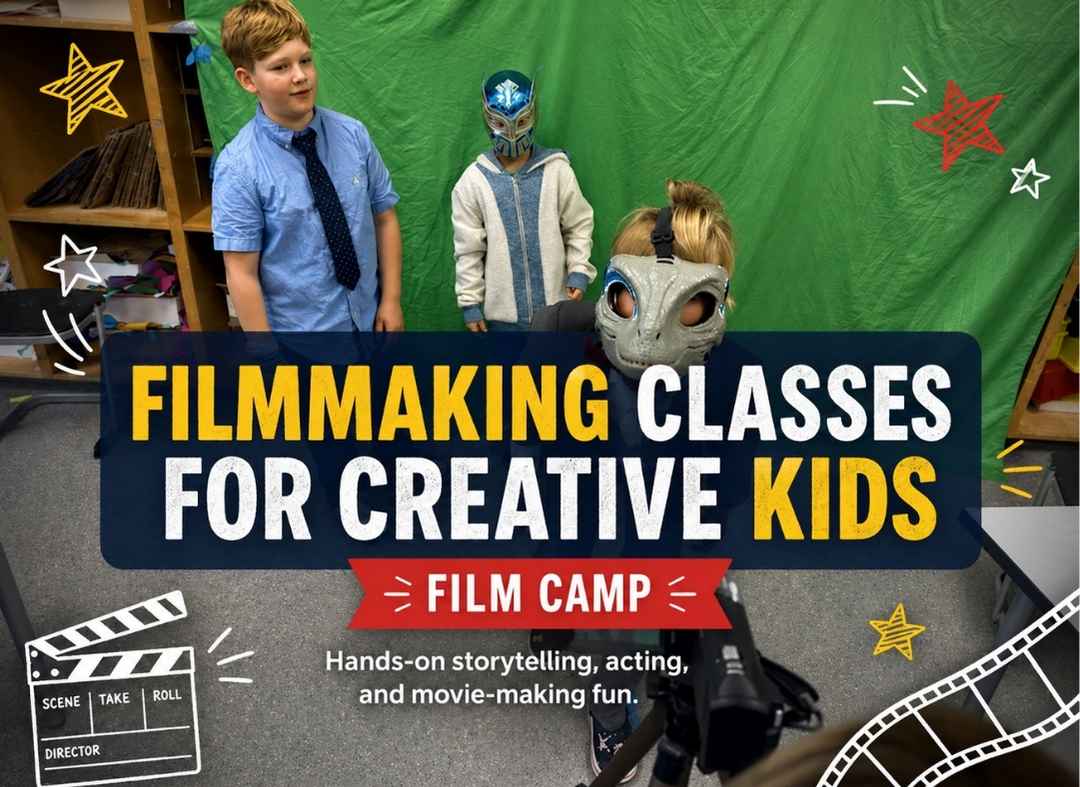
Discover why filmmaking classes help creative kids build confidence, teamwork, and storytelling skills through hands-on movie projects at Film Camp Los Angeles, where beginners learn by creating real short films.
Read >.jpg)
Weekend film classes in Los Angeles teach kids ages 8 to 14 filmmaking every Sunday in Glendale. Compare real costs, curriculum, safety, and what to ask before enrolling your child.
Read >
Thanksgiving break film camps fill the three school-free days in Austin, Los Angeles, and San Francisco. Kids ages 7 to 14 write, shoot, edit, and premiere their own short film.
Read >.jpg)
Discover how kids ages 7–14 learn screenwriting, acting, directing, camera work, editing, teamwork, and confidence at Los Angeles Film Camp in Glendale while creating and premiering their own short film.
Read >.png)