Before signing any media release, parents should understand child filming laws, consent rights, online safety, and usage terms to protect their child’s image, privacy, earnings, and future opportunities.
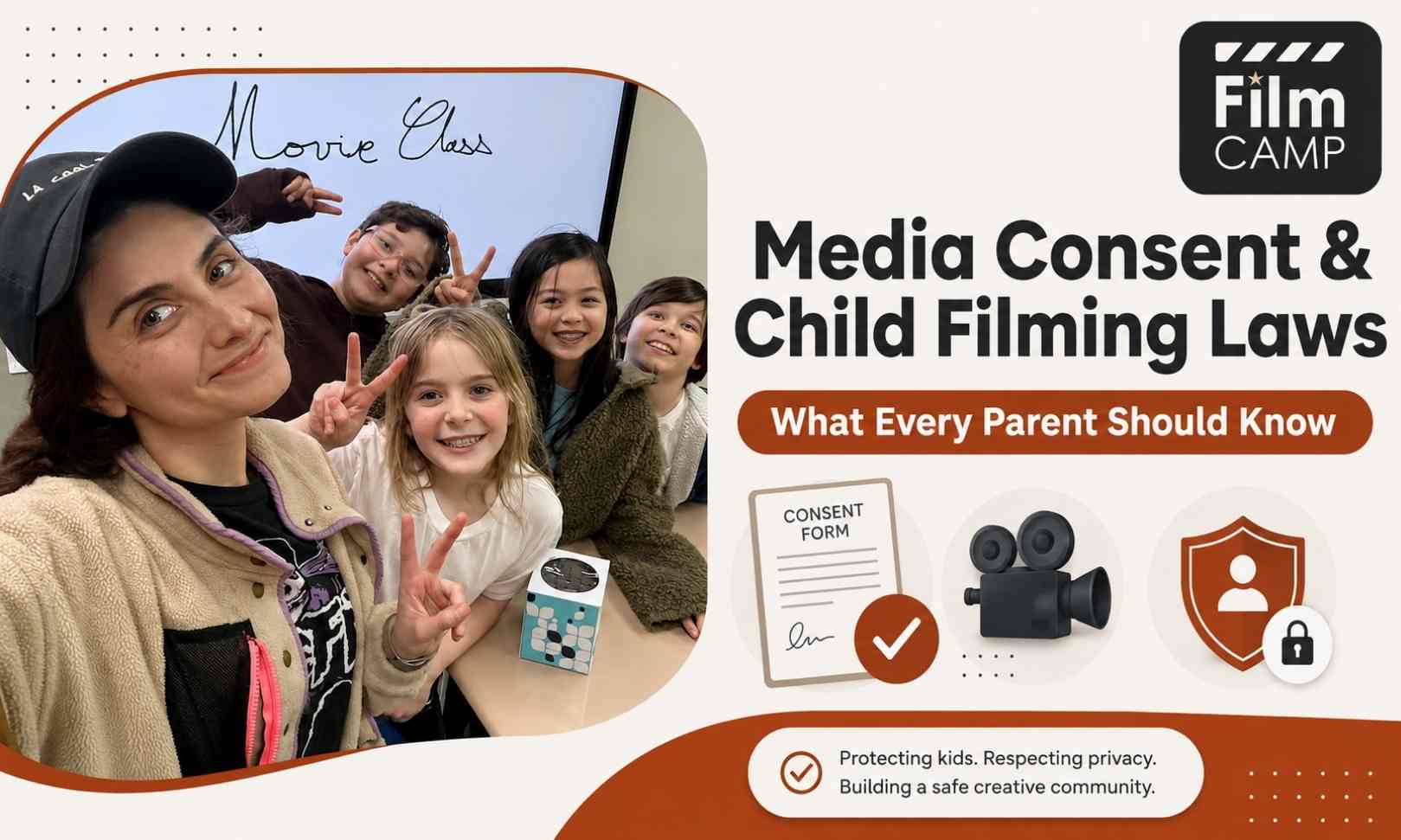
So your kid wants to make movies. Cool. They've watched every YouTube tutorial. They've borrowed your phone for "research." Now they want into a real film camp.
Then a form lands in your inbox. Three pages. Words like "likeness," "irrevocable," "perpetuity." Your eyes glaze. You sign it anyway.
Sound familiar?
Here's the truth most parents miss. That form matters more than the popcorn at the premiere. Media consent and child filming laws shape your kid's safety, earnings, and digital future. Skip the fine print, and you might sign away rights for life.
This guide walks you through it all. Plain talk. No legal jargon. Just what you need before your kid steps in front of a camera at a summer film camp, a school shoot, or a paid gig.
We run Film Camp out of Austin, Texas. We've worked with thousands of young filmmakers. We've seen the good consent forms. We've also seen the ones that should have been shredded.
Grab a coffee. Let's break it down.
Media consent is a permission slip with teeth. It tells filmmakers what they can and can't do with your child's image, voice, name, and stories.
Think of it as a fence around your kid's face. Without it, the fence has holes. Anyone can walk through. With it, you decide who comes near.
For minors, consent works a little different. Kids can't legally agree to most contracts. So you, the parent or legal guardian, sign on their behalf. That's a big responsibility.
A solid media release usually covers:
We see this every summer at our film camp austin programs. Parents sign first, then call us a week later with questions. We get it. The forms feel scary.
But that fear fades fast when you know what each section means. Let's keep going.
Each state writes its own rulebook. But some federal laws apply everywhere.
The Fair Labor Standards Act (FLSA) sets work-hour limits for kids in entertainment. School can't get tossed aside for shoots. Even on a small set.
The Children's Online Privacy Protection Act (COPPA) controls how kids' info gets used online. Anything posted on YouTube, TikTok, or a public website falls under COPPA. Big deal for anyone shooting content for the web.
The Family Educational Rights and Privacy Act (FERPA) kicks in if filming happens at school. Teachers and admins must follow strict rules.
Quick federal snapshot:
Texas, California, New York. Each writes its own playbook on top of the federal stuff. We'll cover those next.
Here's a Texas saying we love. Don't put the cart before the horse.
Signing first and reading later? Pure cart-before-horse energy. A media release can lock in rights for life. Yes, life. The word "perpetuity" means forever.
What's the worst case if you skip the fine print?
Your kid's face shows up in a beer commercial ten years later. You hate the brand. You can't pull the footage. The release said yes back in fourth grade.
That's not made up. That's how rights work in the film world.
Smart parent questions before signing anything:
Treat every release like a real contract. Because it is one.
The same goes for our film camp for teens in austin programs. We hand out releases. We expect parents to read them. We answer every question.
We run a film camp for teens in Austin and partner with programs across the country. Consent is part of day one. Not buried. Not rushed.
Every parent gets a clear form. We walk through it together. Questions are welcome. We don't push you to sign on the spot.
At Film Camp, our policy keeps things simple:
Our austin film classes work with teens making real short films. So we treat their work like real work. With real safeguards.
If your kid joins our teen summer camps austin film program, you'll know what's filmed, why, and where each clip ends up. No surprises. No fine print traps.
We also love being clear with the film kids austin crowd, the younger campers. Younger kids need extra care. Their faces shouldn't end up on the open internet without thought.
States get pretty specific. Let's hit the big ones.
Texas leans film-friendly. Less red tape than California. But child labor laws still apply on every shoot.
Kids under 14 face tight work hour limits. Permits aren't always needed for very short shoots. But schools and parents must sign off in most cases.
Our austin kids camp programs follow Texas guidelines. We also go beyond what the state requires. We add extra check-ins, extra breaks, extra parent updates.
The video production camp rrisd crowd in Round Rock also follows Central Texas rules. Same playbook. Different zip code.
California is strict. For good reason. Hollywood draws thousands of young performers every year.
The Coogan Law protects child actors' earnings. Studios must put 15 percent of what your kid earns into a blocked trust account. The money waits for your kid until they're 18. No early spending. No parent withdrawals.
Studios also need work permits for any minor. School tutors must be on set for long shoots. Hours are tightly tracked.
Our california film summer camp partners follow these rules to the letter. Same with our film camp glendale connections. And our film summer camp los angeles affiliates run the same playbook.
Similar vibe to California. Tough on permits. Strong on trust accounts. Trust funds are required for paid work.
Florida and Georgia are booming film hubs now. Both have child performer laws, but the rules vary. Always check local labor offices before any shoot.
Other states fall somewhere in between. The lesson? Check local rules every single time. Don't assume.
Mistakes happen. We've seen them all.
Mistake one: signing without reading. Some forms hand over rights for life. Read every single line. Even the tiny print at the bottom.
Mistake two: assuming one form covers everything. A camp release might not cover a film festival submission. Or a Netflix licensing deal. Ask what's included and what isn't.
Mistake three: only one parent signs. Some states need both. Especially in custody cases. Check the rules where you live first.
Mistake four: ignoring the social media clause. Footage often ends up on Instagram, TikTok, or YouTube. Decide upfront if that's okay for your family.
Mistake five: forgetting the kid's voice. Your child has thoughts too. Especially teens. Loop them in. Talk about what they want to share.
Mistake six: tossing the signed copy. Always save a copy. Digital and paper. You'll want proof if questions come up later.
Ever feel like the form is in another language? You're not alone. Most parents feel the same. That's why we slow down with families at our summer film camp sessions.
Forms aren't built for clarity. They're built for coverage.
But you can crack the code with a few key tricks. It's a bit like reading a menu in a foreign country. Once you know the words, the meal makes sense.
Look for these red flag words:
Read those clauses twice. Then ask questions before signing.
Green flag signs of a fair release:
Think of a release like a menu. You should know exactly what you're ordering before the food shows up.
This is where things get sticky. Online lives forever.
A clip on TikTok today can resurface in college applications later. Or worse. Predators scan public posts. Identity thieves grab birthdays, names, and school logos.
Safe online rules for kids in film:
For our film kids austin students, we keep social media use opt-in only. Default is private. Parents choose what gets shared and where.
Why does this matter so much? Because a kid's digital footprint is like a tattoo. It's hard to remove. Your job is to keep it small and clean.
For older campers in our summer film camp programs, we also teach them how to manage their own digital presence. Knowing the rules early saves headaches later.
Filmmakers, this part's for you. Or for parents helping their kid run their own small projects.
Hiring or featuring minors comes with weight. You're not just making movies. You're handling a child's career, safety, and online reputation.
Filmmaker checklist for minors:
Our video production camp rrisd connections train teens to respect these rules from the ground up. Future directors learn ethics before camera tricks.
A good film set treats minors like glass. Strong, capable, but handled with care.
If you're an indie filmmaker hiring a kid for a short, don't skip these steps. Even a one-day shoot needs paperwork. Insurance, consent, and proof of guardianship. Always.
Not every filming situation looks the same. Let's cover a few special cases.
Schools have their own rules. FERPA protects student records, and that often includes video. Many districts send home blanket media release forms each year. Read them.
If your kid joins a school film club or a video production camp linked to a school, ask how releases stack up. School release plus camp release isn't always the same coverage.
Docs often involve real-life moments. Kids in doc footage need extra protection. Especially if the topic is sensitive.
A good doc filmmaker will get parental sign-off, plus the kid's own verbal agreement. That double-check matters.
If your kid posts to YouTube, TikTok, or any platform, they're already a media producer. Teach them to think about consent for others too.
Do they have permission to film their friends? Did they ask before posting? That's a life skill. Not just a legal one.
We weave these lessons into our austin film classes, our teen summer camps austin film sessions, and every other program we run.
Quick tour of what we do. So you know where consent fits into the bigger picture.
We run programs across multiple cities. Each one follows the same core values. Safety. Transparency. Real skills.
Our program lineup includes:
We also stay connected with the california film summer camp community, the film camp glendale scene, and the film summer camp los angeles crowd. Each location has its own flavor. Each one follows the same consent-first ethic.
Want a film camp that takes safety seriously? You found one.
Here are the questions we hear week after week. Real answers from our team.
Only if you say yes. Our default is private. Public posts need separate, written opt-in from parents.
We default to the parent's wishes. Always. We talk through it with the family if there's a gap.
Yes. Send us a written request. We pull the footage from any program-controlled channel within a reasonable timeframe.
If pay enters the picture, we follow state rules. In California, that means Coogan accounts. In Texas, we follow the labor code.
We try hard to keep them plain. No tricky clauses. No "in perpetuity" surprises. Just clear terms.
Every student film inside Film Camp is governed by our internal use rules. Public screening of any film featuring another camper needs that camper's parent's separate sign-off.
Print this. Stick it on the fridge. Bring it to the first day of camp.
The Parent Pre-Set Checklist:
Did you check everything? Then your kid is ready to roll.
We didn't write this guide just for the clicks. We wrote it because we see kids' eyes light up when they hold a real camera. That spark deserves protection.
Our team has worked with young filmmakers across Austin, LA, Glendale, Round Rock, and beyond. We've seen the good releases. We've seen the bad ones. We know the difference matters.
What we promise families at Film Camp:
When parents trust us, kids thrive. Trust starts with consent done right.
Movies aren't made in front of the camera alone. They start with paperwork. Boring, important paperwork.
Get the consent right, and the rest of the story flows. Skip it, and you're filming on shaky ground.
So next time a release lands in your inbox, slow down. Read it. Question it. Sign smart.
Your kid's first film should be a memory worth keeping. Not a regret tucked inside a contract.
Want to talk to us before signing your kid up for any of our film, movie, or video programs? Call us at (323) 471-5941. Or email hello@film.camp. We're at 5900 Balcones Drive, Suite 100, Austin, TX 78731.
Spots fill fast for our summer film camp, our film camp for teens in austin, and our partner programs in California. Reach out and let's chat about your kid's next big creative leap.
Lights. Camera. Consent first.

Discover why filmmaking classes help creative kids build confidence, teamwork, and storytelling skills through hands-on movie projects at Film Camp Los Angeles, where beginners learn by creating real short films.
Read >.jpg)
Weekend film classes in Los Angeles teach kids ages 8 to 14 filmmaking every Sunday in Glendale. Compare real costs, curriculum, safety, and what to ask before enrolling your child.
Read >
Thanksgiving break film camps fill the three school-free days in Austin, Los Angeles, and San Francisco. Kids ages 7 to 14 write, shoot, edit, and premiere their own short film.
Read >.jpg)
Discover how kids ages 7–14 learn screenwriting, acting, directing, camera work, editing, teamwork, and confidence at Los Angeles Film Camp in Glendale while creating and premiering their own short film.
Read >.png)