Film Camp Austin builds leadership in kids through filmmaking, teamwork, decision-making, communication, and creative responsibility, helping them grow confidence, resilience, and real-world leadership skills.
.jpg)
Every parent wants their kid to grow up confident. Decisive. Someone who steps up when things get hard.
But leadership doesn't show up on its own. It needs the right conditions.
School doesn't always provide those conditions. Sports teams get close. But there's one place that does it better than most people realize.
Summer camp.
Not just any camp. The kind that puts real decisions in kids' hands. Real stakes. Real teams counting on them.
At Film Camp, we put kids in charge of actual creative projects. They lead crews. They make calls. They own the outcome.
As they say in Texas: "Even the biggest tree was once just a seed that decided to grow." Leadership starts small. Camp is where that seed gets planted.
This post covers everything parents and educators find when they search this topic. The research. The real skills. And why film-based camp builds leaders in a way most programs simply don't.
Search "leadership skills kids learn at camp" and you'll mostly find listicles. Generic ones. Bullet points about "responsibility" and "communication" with no real explanation.
You'll find articles about outdoor adventure camps. Ropes courses. Team challenges in the woods.
What you almost never find is a deep look at creative leadership. The kind built in a film production environment. The kind where a 12-year-old is directing a scene and the whole crew is waiting on her next decision.
That's the gap. And it's where Film Camp Austin sits.
We're at 5900 Balcones Drive, Suite 100, Austin, TX 78731. Call (323) 471-5941 or email hello@film.camp to learn more.
Leadership is a skill. Not a personality type.
That matters. Because skills can be taught. Skills can be practiced. Skills improve with repetition.
Camp is one of the few environments where kids get genuine leadership reps. Not pretend ones. Not hypothetical classroom scenarios.
Real ones. With real crews. Real deadlines. Real results.
Leadership grows through experience, not through lectures. Camp provides the experience.
A director makes dozens of decisions before lunch.
Which angle works? Should we reshoot that? Is the lighting good enough? Does this scene move fast enough?
Kids in the director's role at Film Camp face all of these. They can't pass the decision up the chain. There is no chain. It's their call.
That repeated experience of making decisions, seeing results, and adjusting is how real decision-making confidence is built. Not in theory. In practice.
Think of it like driving. You can read the manual all you want. You don't actually learn until you're behind the wheel.
When you're in charge, things feel different.
When your decision affects someone else's work, you stop being careless. You think harder. You follow through.
Film Camp gives every kid a leadership role at some point. Director. Producer. Set manager. Each one carries real responsibility.
Kids feel the weight of that. And that weight is a good thing.
Accountability isn't something you can download. It's something you earn through experience. Camp accelerates that process.
Good leaders communicate clearly. That's not optional.
On a film set, unclear communication breaks everything. Wrong camera angle. Wrong line reading. Wrong timing. All of it traces back to someone not communicating well.
Kids learn this firsthand. They have to explain what they want. Clearly. Directly. Without confusion.
And when they don't do it well, they see the results immediately. Then they try again.
That rapid feedback loop makes communication skills stick faster than any classroom exercise.
Put five kids together on a creative project and you'll get conflict. Guaranteed.
"My idea is better." "You're doing it wrong." "That's not what we agreed on."
This is not a problem. This is the curriculum.
Learning to resolve conflict, hear different viewpoints, and find a path forward is one of the most critical leadership skills in adult life. Film camp gives kids a safe place to practice it early.
They leave knowing how to disagree without blowing up the team. That skill is worth more than most people realize.
Great directors understand people. Not just cameras.
They know when a crew member is frustrated. They know when a performer needs encouragement. They know when to push and when to give space.
This is emotional intelligence. And film camp builds it through direct experience.
Kids learn to read the room. To adjust their approach based on what others need. To lead with empathy, not just authority.
Emotional intelligence is the hidden foundation of all great leadership. Camp puts it front and center.
Something always goes wrong on set. Always.
Weather changes. Equipment fails. A scene just doesn't work the way it looked on paper.
Kids in leadership roles at Film Camp can't freeze. They have to assess the situation, think through options, and make a call fast.
Over time, this builds strategic thinking. The ability to zoom out. See the big picture. Make smart moves under pressure.
That's not just a film skill. That's a life skill. One that compound interest kicks in on for decades.
Some of the most powerful leadership moments at camp don't come from adults.
They come from one kid encouraging another. A senior camper showing a new one how to frame a shot. A natural leader stepping up to help the group when things stall.
Peer leadership is powerful because it feels real. It feels earned.
Kids trust other kids. And when one of their own steps up with skill and kindness, the whole group lifts.
Film Camp creates those moments intentionally. We don't just teach leadership. We create the conditions for it to happen organically.
Every leader has to sell an idea eventually.
At Film Camp, kids pitch their film concepts to the group. They stand up and say "here's what I want to make and why."
That's terrifying the first time. Less the second time. By the third time, it feels almost natural.
This practice builds something important. A voice. The confidence to say "here's my idea" without apologizing for it.
Leaders who can articulate their vision clearly are rare. Camp starts building that skill early.
There's a word for kids who wait to be told what to do: followers.
There's another word for kids who see what needs doing and just do it: leaders.
Film Camp rewards initiative. The kid who spots a problem and fixes it. The one who has an idea and acts on it without being asked. The one who keeps the project moving when energy dips.
Ownership of outcomes is the core of leadership. And film projects are the perfect vehicle for it.
Not every take lands. Not every film turns out the way the director imagined.
What happens next is the real test.
Do they give up? Do they blame the team? Or do they take a breath, learn from it, and go again?
Kids who go through that cycle at Film Camp come out tougher. Not in a hardened way. In a flexible, bouncy way.
Resilience is like a rubber band. It stretches. Then it snaps back. The more it stretches safely, the more elastic it becomes.
The effects of camp leadership training don't stay at camp.
Parents notice it quickly. Their child speaks up more at the dinner table. Takes initiative on homework. Volunteers for things they would have avoided before.
Teachers notice it too. More confidence in presentations. Better group project participation. Clearer communication with peers and adults.
These aren't coincidences. They're the downstream results of a summer spent leading real projects with real outcomes.
Leadership built at camp shows up everywhere. That's the whole point.
A lot of camps say they build leaders. Fewer actually do.
The difference is in the method.
Telling kids to be leaders doesn't work. Giving them a leadership badge doesn't work. Putting them in charge of something that actually matters? That works.
At Film Camp Austin, every leadership moment is earned. Every role is real. Every project has an audience. Every decision has a visible result.
The city of Austin adds something too. It's a place that values creative leadership. Innovation. Bold ideas.
Kids feel that energy here. And it shapes how they think about what's possible for them.
Parents often say they weren't ready for the change.
They sent a kid who wouldn't speak up in restaurants. They picked up a kid who'd just directed a five-minute film and wanted to tell them everything about it.
The relief is real. Not because the camp "fixed" anything. But because they finally saw what their kid was capable of all along.
And when a child sees that too? That's when real, lasting confidence kicks in. Not the borrowed kind. The earned kind.
That's the Film Camp difference. And it starts the first day of summer.
You don't need to find a natural-born leader.
You just need to find the right environment to let your kid become one.
Film Camp is that environment. We give kids the real-world experience, the creative tools, and the supportive crew they need to lead. For real.
Because leadership isn't about being the loudest in the room. It's about knowing what you want, communicating it clearly, and bringing people with you.
Your kid can do that. We'll show them how.
Call us at (323) 471-5941. Email hello@film.camp. Or come visit us at 5900 Balcones Drive, Suite 100, Austin, TX 78731. We'd love to meet your future filmmaker. And your future leader.
Q1: What leadership skills do kids actually develop at summer camp? Kids build decision-making, communication, conflict resolution, accountability, and emotional intelligence. Film camp adds creative leadership and strategic thinking on top of that foundation.
Q2: Can summer camp really teach leadership to introverted kids? Absolutely. Leadership doesn't require being loud or outgoing. Introverted kids often become the most thoughtful, observant leaders. Film camp has behind-the-scenes roles that let leadership show up quietly and powerfully.
Q3: How does filmmaking teach leadership skills? Every film production requires someone to make decisions, guide a team, manage time, and take ownership of the final result. Kids in those roles practice real leadership, not simulated leadership.
Q4: What age is best to start leadership development at camp? Most kids are ready to start between 8 and 12 years old. Film Camp Austin serves a range of ages. Contact us at (323) 471-5941 for specific age group details.
Q5: How does camp build accountability in children? By giving kids real responsibilities with visible outcomes. When your decision affects your team's work, accountability becomes personal. Film camp creates those moments consistently.
Q6: Is Film Camp Austin good for kids who struggle with confidence? It's especially good for them. The camp is designed to build earned confidence through real achievement. Kids don't leave with empty praise. They leave with a finished film they made.
Q7: What is the difference between leadership at camp vs. school? At school, leadership opportunities are often rare and competition is high. At camp, every child gets genuine leadership reps in a supportive, lower-stakes environment. The ratio of doing to waiting is completely different.
Q8: Can kids with no film experience still develop leadership skills at Film Camp? Yes. No experience needed. The leadership growth happens through the process, not through existing skill. Beginners often show the most dramatic leadership development across a single session.
Q9: Does Film Camp Austin pair leadership development with creative skill-building? That's exactly the model. Creative skills and leadership skills are taught together through real film projects. You can't separate them at Film Camp. They grow at the same time.
Q10: How do I get my child enrolled at Film Camp Austin? Reach out directly. Call (323) 471-5941, email hello@film.camp, or visit us at 5900 Balcones Drive, Suite 100, Austin, TX 78731. We'll walk you through everything and answer any questions you have.

Thanksgiving break film camps fill the three school-free days in Austin, Los Angeles, and San Francisco. Kids ages 7 to 14 write, shoot, edit, and premiere their own short film.
Read >.jpg)
Discover how kids ages 7–14 learn screenwriting, acting, directing, camera work, editing, teamwork, and confidence at Los Angeles Film Camp in Glendale while creating and premiering their own short film.
Read >
Young filmmakers gain professional movie-making skills through hands-on projects, learning storytelling, directing, camera work, sound, editing, teamwork, safety, feedback, role rotation, and confidence while completing and premiering their own films.
Read >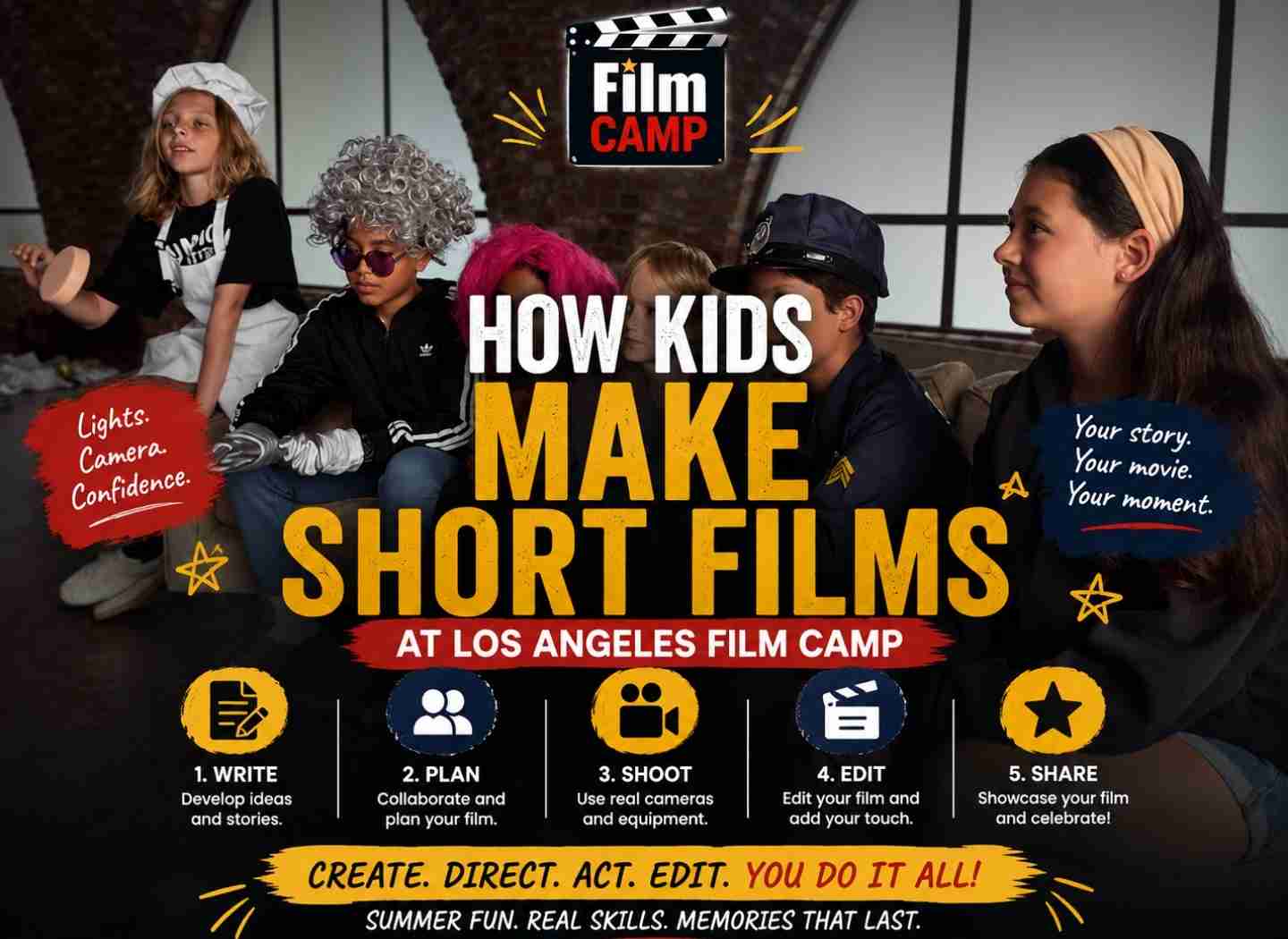
Kids write, shoot, and edit their own short films in one week at Los Angeles Film Camp. Hands-on, safe, and no experience needed. See how it works, from first idea to premiere.
Read >.png)