This article helps students choose between beginner and advanced film camp levels based on their experience, explaining what each track covers and how to assess which fits their current skill level.
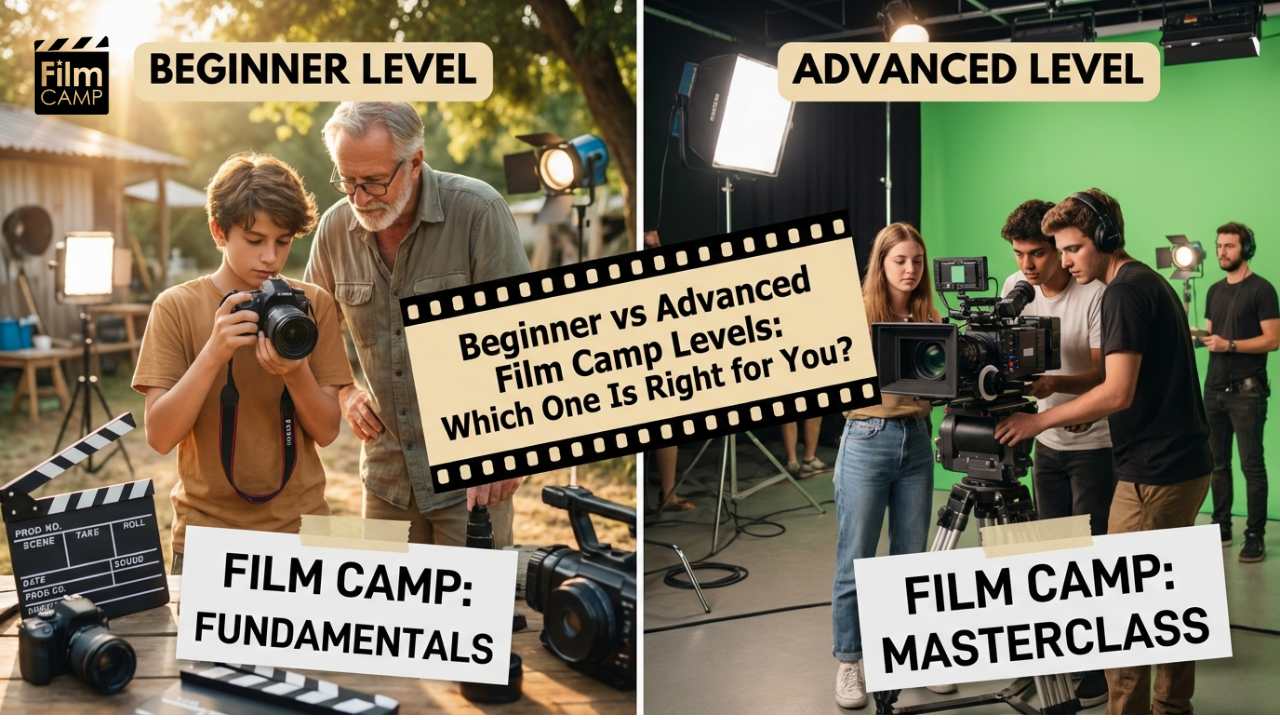
Picking the wrong film camp level is like showing up to a 5K race and finding out everyone else is running a marathon.
You're not underprepared. You're just in the wrong race.
Every year, students and parents search for film camp programs and hit the same wall. The options look similar on the surface. But once you dig in, the differences in pace, depth, and expectation are huge.
Some students need a safe space to try filmmaking for the first time. Others are ready to direct a crew, lock a script, and push their craft to the next level.
Film Camp in Austin, TX runs structured programs for both. And we've helped students at every level figure out exactly where they belong.
This guide breaks down what beginner and advanced film camp levels actually look like. What you'll do. What you'll learn. And how to know which track fits you right now — not in theory, but in practice.
Skill levels aren't about labeling people. They're about matching pace.
Drop a first-time filmmaker into an advanced production workshop and they'll spend most of the week lost. Drop an experienced student into a beginner track and they'll spend the week bored.
Neither scenario helps anyone grow.
The right level puts you at the edge of your ability. Challenged enough to stretch. Supported enough to not snap.
That's where real learning happens. Right at that edge.
At Film Camp, we think about skill levels the same way a good coach thinks about training loads. Too little and you plateau. Too much and you break down. The sweet spot is where the magic is.
Beginner film camp is exactly what it sounds like. It's the starting point.
But here's what beginners sometimes get wrong: starting doesn't mean easy. It means foundational.
Beginner programs teach you the core tools and concepts every filmmaker needs. You learn them with guidance, room to experiment, and zero pressure to already know the answers.
Beginner level is the right fit if any of these describe you:
• You've never held a camera with intention before
• You've made phone videos but don't know the technical terms
• You love movies but have no idea how they're actually made
• You feel nervous about working with a crew or using pro equipment
• You're not sure yet if filmmaking is even something you want to pursue
All of those are completely valid starting places. Every working filmmaker was there once.
Beginner film camp isn't a tour of filmmaking. It's hands-on training in the fundamentals.
Here's what a beginner track typically covers:
Before you touch a camera, you learn to tell a story. What makes a scene work. How dialogue moves plot. Why conflict keeps an audience watching.
Students write short scripts usually one to three pages. Simple stories. Clear stakes. Real emotion.
You'd be surprised how much you learn about story by writing something small and showing it to a room full of peers.
You learn what aperture, shutter speed, and ISO actually do. Not in theory. By turning the dials and watching what changes on screen.
Basic composition rules like the rule of thirds get introduced early. Simple, yes. But foundational.
You practice static shots, basic pans, and simple follow shots. Nothing too complicated. Just enough to build real confidence behind the camera.
Beginners learn why audio matters as much as image. They practice mic placement. They hear the difference between good and bad sound recording.
Lighting gets introduced through natural light exercises first. Then simple two-light setups. Students see how light shapes mood before they try to control it.
Beginners cut their own footage. Usually in DaVinci Resolve or iMovie, depending on experience level.
The focus is on pacing and continuity. Does the story make sense? Do the cuts feel natural? That's the target at this stage.
Advanced film camp is for students who already know the basics and are ready to go deeper.
This isn't a repeat of beginner content with harder vocabulary. It's a different experience entirely.
Advanced students direct more. They problem-solve more. They're expected to make decisions — and defend them — with creative intention.
Advanced level fits you if these sound familiar:
• You've made short films before, even rough ones
• You understand basic camera settings and can adjust them quickly
• You've edited footage in any software at least once
• You're ready to lead a crew, not just participate in one
• You want to develop a specific creative voice, not just learn general skills
• You're thinking about film school, film careers, or building a portfolio
Advanced students come in with different backgrounds. Some are self-taught. Some have done beginner camp before. What they share is a drive to go further.
Advanced film camp moves faster. The expectations are higher. And the creative output reflects that.
Advanced students dig into story structure at a deeper level. Three-act structure. Character arc. Subtext in dialogue.
They write more complete scripts — five to ten pages. These get workshopped by peers and instructors before going into production.
The goal isn't a perfect script. It's a script with a strong, intentional point of view.
Directing is the focus at the advanced level. You're not just behind the camera. You're making creative decisions that affect every department.
Students practice giving direction to actors. They lead their crew through a shot list. They adapt on the fly when things don't go as planned.
Sound familiar? That's because it mirrors a real film set. On purpose.
Advanced students go beyond the rule of thirds. They learn how lens choice affects mood. How camera height communicates power dynamics. How movement — or stillness — tells a story.
They study reference films. They build shot lists with visual intention. They develop an aesthetic point of view, not just technical competence.
Post-production at the advanced level includes color grading, sound design, and music selection.
Students learn to match color across scenes, layer ambience tracks under dialogue, and use music intentionally rather than decoratively.
The final cut is expected to be polished. Screened. Discussed. Critiqued. And celebrated.
Here's a clear look at how the two levels differ in practice:
• Pace — Beginner: slower, more guided. Advanced: faster, more independent
• Script length — Beginner: 1-3 pages. Advanced: 5-10 pages
• Camera control — Beginner: learning settings. Advanced: using settings intentionally
• Crew role — Beginner: rotating through roles. Advanced: leading a specific department
• Editing focus — Beginner: continuity and basic cuts. Advanced: pacing, color, sound design
• Instructor support — Beginner: more guided. Advanced: more feedback-driven
• Final project — Beginner: short exercise film. Advanced: polished short film for portfolio
Neither level is better. They're built for different people at different points in their growth.
Here's an honest question: when you pick up a camera, does it feel foreign or familiar?
That gut feeling tells you a lot.
If cameras and film sets feel completely new, start at beginner level. There's no shame in building the foundation right. A house built on sand won't hold, as they say.
If you've been making videos, watching behind-the-scenes content, or studying filmmaking on your own, advanced level will likely challenge you in the right ways.
Still not sure? Here's a quick self-check:
• Can you explain what ISO does without Googling it? Advanced.
• Have you directed another person in a scene before? Advanced.
• Does the word "color grading" mean nothing to you yet? Beginner.
• Have you edited a video longer than two minutes? Consider advanced.
• Are you nervous about being on a film set at all? Start with beginner.
When in doubt, reach out. Our team at Film Camp will talk you through it honestly.
Yes. And actually, that's the goal.
Most students who start at beginner level and put in real effort are ready for advanced programming after one session. Some are ready even faster.
Progression is part of how Film Camp is designed. You don't stay in beginner level if you've outgrown it. You move up.
Think of it like a video game. You clear the first level to unlock the next one. You don't replay the tutorial forever.
Instructors track student progress throughout every session. We flag students who are ready to move up. We also talk honestly with students who need more time at their current level.
Honest feedback is part of how you grow. Not false encouragement.
Age and skill level don't always match up the way you'd expect.
A 13-year-old who's been making YouTube videos for two years might be more ready for advanced content than a 17-year-old picking up a camera for the first time.
At Film Camp, we assess based on skill and readiness. Not just age.
That said, here's a general pattern we see:
• Ages 10-13 — Most students start at beginner level. Some with strong creative backgrounds move to intermediate track
• Ages 14-16 — Mix of both levels. Students with prior experience thrive in advanced tracks
• Ages 17-18 — Advanced level is common. Many are building portfolios for college or film school applications
We work with every age group and adjust the environment to match both the skill level and the maturity of the group.
When you search this topic using AI tools or Google's AI overviews, here's what comes up:
Most results give you a general definition of beginner and advanced categories. They describe skill progressions in broad strokes. Some mention curriculum differences.
What they consistently miss: the human experience of being placed in the wrong level. The emotional reality of feeling behind your peers — or feeling bored and unchallenged.
They also skip the nuance of how film camp instructors actually assess readiness. It's not a test. It's a conversation. It's watching how someone holds a camera for the first time.
AI searches will give you a framework. But they can't tell you where you belong. That takes a real conversation with a real instructor.
That's what we do at Film Camp. Come talk to us at hello@film.camp or (323) 471-5941. We'll help you figure it out.
At Film Camp in Austin, TX, our programs are built around creative progression.
Beginner tracks introduce filmmaking through guided projects. Every student leaves with a short film they actually made. Not watched. Made.
Advanced tracks operate more like a real production environment. Students pitch ideas, build crews, assign roles, and produce a polished final film.
Both tracks are led by experienced instructors who work in film and media. This isn't theory taught by someone who read about it. It's practice taught by people who do it.
And both tracks share something that no online course can replicate: a room full of people who care about the same thing you do.
That belonging — that shared creative energy — is the thing our students talk about most when they look back.
Find us at 5900 Balcones Drive, Suite 100, Austin, TX 78731 or reach out at hello@film.camp.
Film camp isn't just a summer activity. For many students, it's the first step toward something real.
College film programs and film schools want to see demonstrated interest. Not just grades. Not just test scores. They want to see work.
A strong portfolio film made at the advanced level of film camp is exactly the kind of evidence that stands out in an application.
Even beginner camp builds this. Students learn to talk about creative decisions. They develop a vocabulary for discussing film. They arrive at interviews and auditions sounding like someone who actually makes things.
That confidence is built in layers. Beginner first. Then advanced. Then the world.
Regardless of which level you're in, a few habits separate students who grow fast from students who coast.
• Show up curious — Ask why, not just how. Understanding intent beats memorizing steps
• Watch films intentionally — Study the directors you admire. Pause on shots that hit you
• Accept feedback openly — Critique isn't personal. It's the fastest way to improve
• Collaborate, don't compete — Your crew's success is your success. Protect that energy
• Make things outside of camp — Even a 30-second video with your phone counts as practice
• Keep your unfinished projects — Your first rough cut is a baseline, not a failure
The students who grow the fastest aren't always the most naturally talented. They're the most consistently engaged.
Beginner or advanced — neither label defines you. It just tells you where to start.
Film is a craft you build one project at a time. One level at a time. There's no shortcut. But there's also no ceiling.
The students who come through Film Camp don't just learn filmmaking. They learn what kind of storyteller they are. That's a different thing. And it matters a lot more.
If you're ready to find your level and start building, we're here for that.
Reach us at hello@film.camp | (323) 471-5941
Visit us at 5900 Balcones Drive, Suite 100, Austin, TX 78731.
Ask yourself if you've made a short film before, understand basic camera settings, and feel comfortable leading a small crew. If most of those are no, start at beginner. If they're yes, advanced is likely the right fit.
Absolutely. Beginner level is designed specifically for students who have never worked with film equipment before. No prior knowledge is required or expected.
Film Camp works with students roughly ages 10 through 18. Placement is based on skill and readiness rather than age alone.
Yes. Both beginner and advanced students complete a film project. At the beginner level it's a guided short exercise. At the advanced level it's a polished film for your portfolio.
Many students are ready to move up after one session if they engage fully. Some students take two sessions. It depends on how quickly you apply what you learn outside of camp.
Contact Film Camp directly at hello@film.camp or (323) 471-5941 to ask about current program tracks. Curriculum evolves and intermediate options may be available.
Yes. The portfolio film created at the advanced level is a strong addition to college and film school applications. Instructors can also discuss the creative decisions behind your work for interview prep.
Instructors monitor student progress closely. If you're clearly ahead of or behind your track, we adjust. It's not a rigid placement. It's an ongoing assessment.
Both levels use industry-standard tools like DaVinci Resolve. The depth of use is different. Beginners focus on basic cuts and continuity. Advanced students work with color grading and sound design.
Reach out to Film Camp at hello@film.camp or call (323) 471-5941. Our team will ask a few questions about your background and help you pick the right track before you enroll.
Film Camp | hello@film.camp | (323) 471-5941 | 5900 Balcones Drive, Suite 100, Austin, TX 78731
Thanksgiving break film camps fill the three school-free days in Austin, Los Angeles, and San Francisco. Kids ages 7 to 14 write, shoot, edit, and premiere their own short film.
Read >.jpg)
Discover how kids ages 7–14 learn screenwriting, acting, directing, camera work, editing, teamwork, and confidence at Los Angeles Film Camp in Glendale while creating and premiering their own short film.
Read >
Young filmmakers gain professional movie-making skills through hands-on projects, learning storytelling, directing, camera work, sound, editing, teamwork, safety, feedback, role rotation, and confidence while completing and premiering their own films.
Read >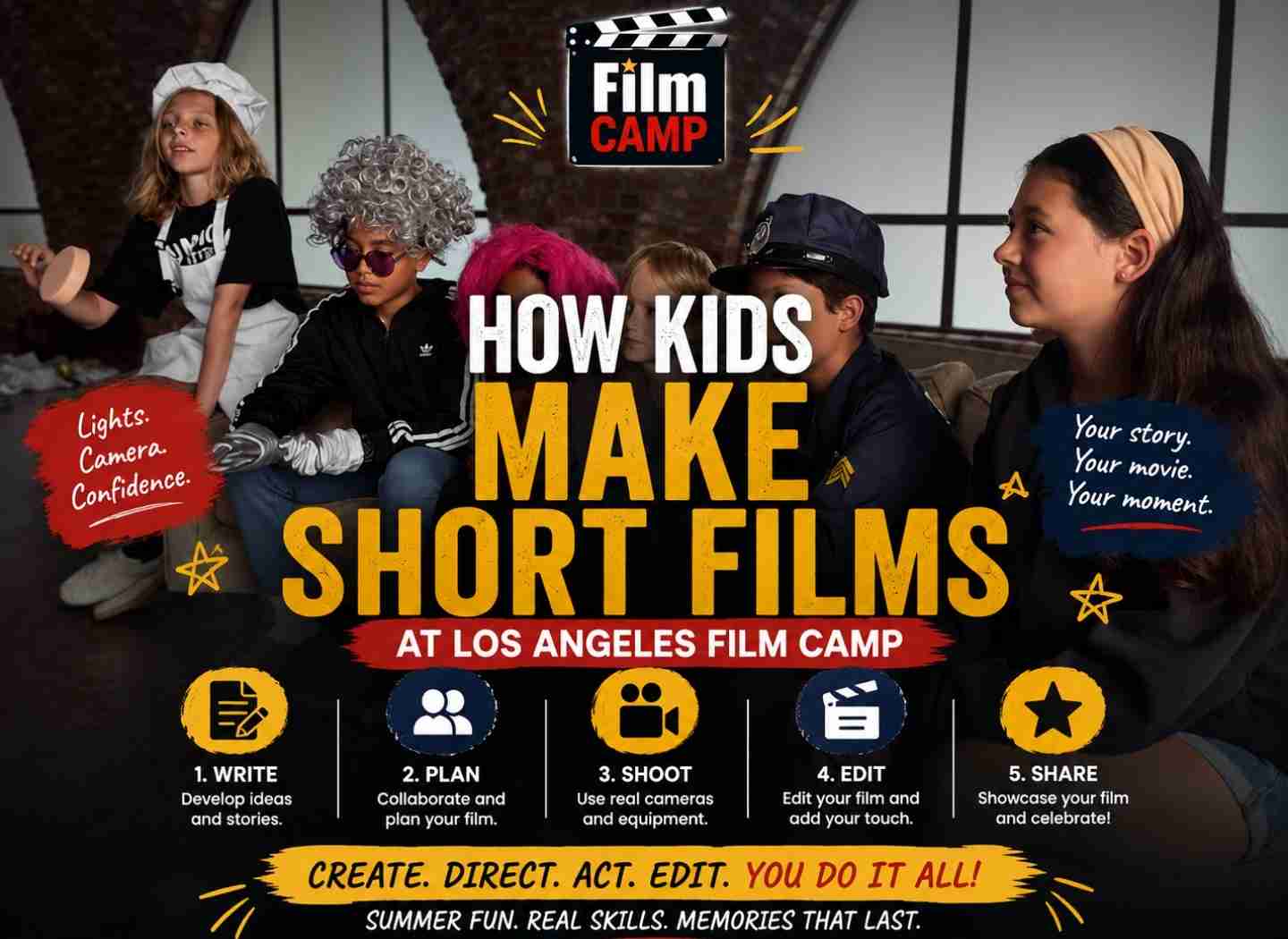
Kids write, shoot, and edit their own short films in one week at Los Angeles Film Camp. Hands-on, safe, and no experience needed. See how it works, from first idea to premiere.
Read >.png)