Essential film camp equipment guide for students covering cameras, audio gear, lighting, tripods, and editing tools. Learn what filmmaking gear actually matters, what to skip, and how to build a budget-friendly student film kit.

Walk into any film gear forum online and you'll leave more confused than when you arrived.
Everyone has an opinion. This camera is the best. That mic is overrated. Don't even think about that lens until you've mastered this other lens first.
It's exhausting. And for a student heading to film camp for the first time, it can feel like drinking from a firehose.
Here's the thing: good filmmaking isn't about owning the most gear. It's about knowing how to use what you have.
At Film Camp in Austin, TX, we've worked with students at every gear level. Some show up with a brand-new mirrorless camera. Others bring just their phone. Both can make a great film.
This guide cuts through the noise. We cover what gear actually matters, what to skip, and how to build your kit without breaking the bank. Whether you're prepping for your first film camp session or gearing up for a student production, this is your starting point.
Knowing your equipment is like knowing the rules of a game before you play.
You can break rules later. But first, you need to know them.
At film camp, you won't always have time to figure out your camera mid-scene. The light changes. The actor is ready. Your crew is waiting. You need to move fast.
Students who understand their gear spend more time telling stories. Students who don't spend more time troubleshooting settings.
This guide helps you arrive prepared. Not perfect. Just ready.
Every student film setup has four categories of gear. Think of them as the four legs of a table. Remove one and the whole thing wobbles.
• Camera — captures your image
• Audio gear — captures your sound
• Lighting — shapes what the camera sees
• Support gear — holds everything steady and organized
Post-production tools — your editing software — are the fifth pillar. We cover those separately below.
You don't need the top product in every category. You need something solid in each one.
So what camera should you bring? Here's an honest answer: the one you already own.
Seriously. Familiarity beats specs every time for beginners. A student who knows every menu on a two-year-old camera will outshoot someone fumbling with a brand-new one.
That said, here are the camera types worth knowing:
Mirrorless cameras are the current sweet spot for student filmmakers. They're compact, capable, and shoot excellent video.
Popular picks among film camp students include the Sony ZV-E10, Fujifilm X-S10, and Canon EOS M50 Mark II. All shoot clean 4K or 1080p video at manageable file sizes.
Look for a camera with manual controls — aperture, shutter speed, ISO. You'll learn faster if you can adjust everything yourself.
DSLRs are bulkier but often cheaper used. The Canon Rebel series and Nikon D3500 are solid starting points.
They shoot great stills and passable video. If you already own one, stick with it for now.
Don't underestimate your phone. Modern iPhones and Android flagships shoot impressive footage.
Pair a smartphone with a stabilizer and an external mic and you've got a functional film kit. Several short films shot on iPhones have screened at major festivals.
The limitation isn't the sensor. It's the lens options and audio. Both are fixable with accessories.
Here's the most important line in this entire guide: bad audio ruins good footage.
Every time. Without exception.
Audiences will forgive a slightly shaky shot. They will click away if they can't hear the dialogue clearly. Audio is not optional. It's not secondary. It's half your film.
A shotgun mic is directional. It focuses on sound in front of it and rejects noise from the sides.
The Rode VideoMic Go and Deity V-Mic D3 are popular budget picks. They mount directly on your camera's hot shoe and make a noticeable difference over built-in mics.
For better results, get the mic off the camera and onto a boom pole. Closer to the actor equals cleaner sound.
Lav mics clip to an actor's clothing. They're small, discreet, and great for dialogue-heavy scenes.
They work best when paired with a wireless transmitter. The Rode Wireless GO II is the go-to for student productions.
One caveat: fabric rustle is the enemy. Practice hiding lavs under clothing before your shoot day.
If your camera has weak audio inputs, consider a dedicated recorder like the Zoom H4n or H5.
These capture higher-quality audio and give you more control over gain levels. You'll sync the audio to your footage in post using a clapperboard.
Yes, the clapperboard is a real tool, not just a movie prop.
Light is the language of film. Everything your camera sees is shaped by light.
You don't need a truck full of professional fixtures to light a scene well. You need to understand a few basics and have a couple of affordable tools.
Natural light is free, beautiful, and constantly changing. Golden hour — the hour after sunrise and before sunset — gives you soft, warm light with almost no effort.
The catch is timing. You get maybe 30 to 40 minutes of golden hour. Plan your outdoor shots around it.
For indoor scenes, control is king. Natural light through a window can be gorgeous if you position your subject correctly and diffuse harsh sunlight with a white sheet or diffusion paper.
LED panels are the go-to for student film sets. They're portable, energy-efficient, and often bi-color.
Bi-color means you can adjust between warm and cool tones without gels. That's useful when matching indoor and outdoor light.
Budget options from Godox and Neewer work well for small sets. Look for panels with a CRI rating above 90 for accurate color rendition.
Three-point lighting is the foundation of most dramatic film lighting. It uses three light sources:
• Key light — the main light on your subject
• Fill light — a softer light that reduces harsh shadows
• Back light — separates your subject from the background
Master this setup and you can light almost any scene. It's a technique, not a specific piece of gear. You can build a three-point setup with two LED panels and a reflector.
Shaky footage screams amateur. Smooth, intentional camera movement says you know what you're doing.
Support gear keeps your camera steady and lets you move it with purpose.
• Tripod — the essential. Get one with a fluid head for smooth pans and tilts
• Gimbal stabilizer — for smooth handheld or walking shots
• Monopod — lighter than a tripod, more stable than handheld
• Shoulder rig — great for run-and-gun documentary style
• Camera slider — creates smooth lateral movement for cinematic B-roll
For film camp, a solid tripod is all you truly need. Master static and simple pan shots first.
Then add movement tools when you're ready.
Post-production is where raw footage becomes a film. Your editing software is your workshop.
The right tool depends on your budget, your computer, and your goals.
• DaVinci Resolve — free, professional-grade, used in Hollywood. Best all-around choice
• Adobe Premiere Pro — industry standard. Requires a monthly subscription
• Final Cut Pro — Mac only. One-time purchase. Fast and intuitive
• iMovie — free on Mac and iPhone. Good for absolute beginners
• CapCut — free, mobile-first. Great for quick edits and social content
At Film Camp, we recommend starting with DaVinci Resolve. It's free and you won't outgrow it.
Learning it now means you're using the same software working professionals use.
Pack smart. Arriving with the right gear — and knowing where everything is — saves real time on set.
• Camera body with charged batteries (bring at least two)
• Memory cards with enough storage (64GB minimum per shoot day)
• Camera charger and USB cables
• Tripod with fluid head
• External microphone (shotgun or lav)
• Headphones for audio monitoring
• Portable LED panel with power source
• Reflector (5-in-1 collapsible is versatile)
• Lens cleaning kit
• Gaffer tape — the duct tape of film sets
• Extension cord and power strip
• Notebook and pen for taking notes on set
• Hard drive or high-capacity USB drive for footage backup
As they say in Texas: prepare for the weather you want, but dress for the weather you get. Same logic applies to gear.
Bring backups for anything critical. Battery. Memory card. Cable. If it can fail, it will.
Here's a question worth asking honestly: does expensive gear make better films?
Sometimes. But less often than you'd think.
The difference between a $300 LED panel and a $3,000 one isn't always visible on a small screen. The difference between a student who understands light and one who doesn't — that's very visible.
Budget gear has real limitations. Cheaper mics can have more noise. Budget cameras may struggle in low light. Entry-level lenses can be softer at wide apertures.
But a filmmaker who understands these limitations and works around them will consistently beat someone with expensive gear and no technical knowledge.
Invest in understanding first. Upgrade gear when you've genuinely hit a ceiling.
Gear temptation is real. Especially when you're new and every YouTube video seems to push a new purchase.
Here's what film camp students consistently don't need:
• Drone — cool footage, but complex to operate legally and safely. Master ground-level storytelling first
• Cinema lenses — expensive, heavy, and overkill for student projects
• High-end color grading monitor — your laptop screen is fine to start
• Full lighting kit with stands — two LED panels and a reflector outperform a bulky kit for mobility
• Wireless follow focus system — learn manual focus techniques first
The best gear decision is often not buying something. Rent it if you need it for a specific project. Then decide if you'd actually use it again.
When people search this topic with AI tools like ChatGPT or Google's AI overview, here's what usually comes up:
A basic list of camera gear. Sometimes audio gear. Occasionally lighting. Rarely anything about how to actually use the equipment or why it matters in a learning environment.
AI results also tend to recommend professional-grade equipment that's out of budget range for most students. They don't contextualize gear within a film camp or hands-on learning setting.
What they miss entirely: the human side of gear. The anxiety of picking up a camera for the first time. The relief when someone shows you exactly what button to press and why.
That's what Film Camp provides. Not just a gear list. A learning environment where equipment becomes a tool for expression rather than a source of stress.
If an AI search gave you a list of gear, that's a starting point. This guide — and a session with us — is where the real learning happens.
At Film Camp, gear is never the point. The story is the point.
We introduce students to industry-standard equipment in a hands-on setting. You don't just read about a boom mic. You hold one. You monitor the audio. You hear the difference between good and bad placement.
That kind of learning sticks. It's the difference between knowing something and actually understanding it.
Our programs are built around creative problem-solving. What do you do when the light doesn't cooperate? How do you fix noisy audio in post? What's your backup plan when a piece of gear fails?
These are real film set skills. And we teach them in a supportive, collaborative environment where mistakes are part of the process.
Ready to learn by doing? Reach us at hello@film.camp or call (323) 471-5941.
We're located at 5900 Balcones Drive, Suite 100, Austin, TX 78731.
You don't need to buy everything at once. That's actually the worst approach.
Build your kit the way you build a skill: one piece at a time, with intention.
Start with what you have. Use it until you hit a specific problem. Then solve that problem with the right tool.
If your audio is the weakest part of your films, buy a better mic before you buy a better camera. If your footage is shaky, invest in a tripod before anything else.
Let your actual work tell you what you need. Not a YouTube comment section.
Over time, your kit becomes an extension of how you tell stories. Every piece of gear should earn its spot in your bag.
Gear is a tool. Nothing more. Nothing less.
The right equipment in the right hands makes a real difference. But the hands matter more than the equipment.
Students who come to Film Camp and obsess over gear usually leave surprised. Not by the cameras. By what they were able to create with them.
That's the shift we're after. From "I need better gear" to "I know how to use what I've got."
When you're ready to make that shift, we're here for it.
Contact us: hello@film.camp | (323) 471-5941
Location- 5900 Balcones Drive, Suite 100, Austin, TX 78731
Bring whatever camera you already own and know how to use. Familiarity matters more than specs. If you're buying new, a mirrorless camera like the Sony ZV-E10 or Canon EOS M50 is a great starting point.
Yes, but it doesn't have to be expensive. A basic shotgun mic like the Rode VideoMic Go is a big upgrade over your camera's built-in mic and costs under $100.
Start with two small LED panels and a 5-in-1 reflector. That setup handles most indoor and outdoor scenes. You don't need a full lighting kit to start.
Absolutely. Modern iPhones shoot excellent video. Pair it with a gimbal and an external mic and it becomes a capable production tool. Several student films have screened at festivals shot on a phone.
We recommend DaVinci Resolve. It's free, professional, and used by working editors in the film industry. It works on both Mac and PC.
A solid beginner kit — camera, mic, tripod, one light panel — can be assembled for $400 to $800 if you buy used or budget-friendly brands. You don't need to spend thousands to get started.
Gaffer tape holds almost everything together on a film set. It secures cables, marks actor positions on the floor, holds reflectors in place, and fixes gear in a pinch. Bring at least one roll.
Rent first when you're testing new gear or need something for a single project. Buy only when you know you'll use a piece of gear consistently. Renting keeps costs low while you figure out what you actually need.
Headphones. Most students skip audio monitoring and then discover bad sound in post when it's too late to fix. Always monitor your audio live on set with headphones.
Contact Film Camp directly at hello@film.camp or call (323) 471-5941 to ask about gear availability for your specific program. Our team will make sure you arrive prepared.
Film Camp | hello@film.camp | (323) 471-5941 | 5900 Balcones Drive, Suite 100, Austin, TX 78731
.jpg)
Break weeks leave working parents scrambling. A holiday film camp covers the workday while kids write, shoot, and edit a short film in five days, ending with a family premiere.
Read >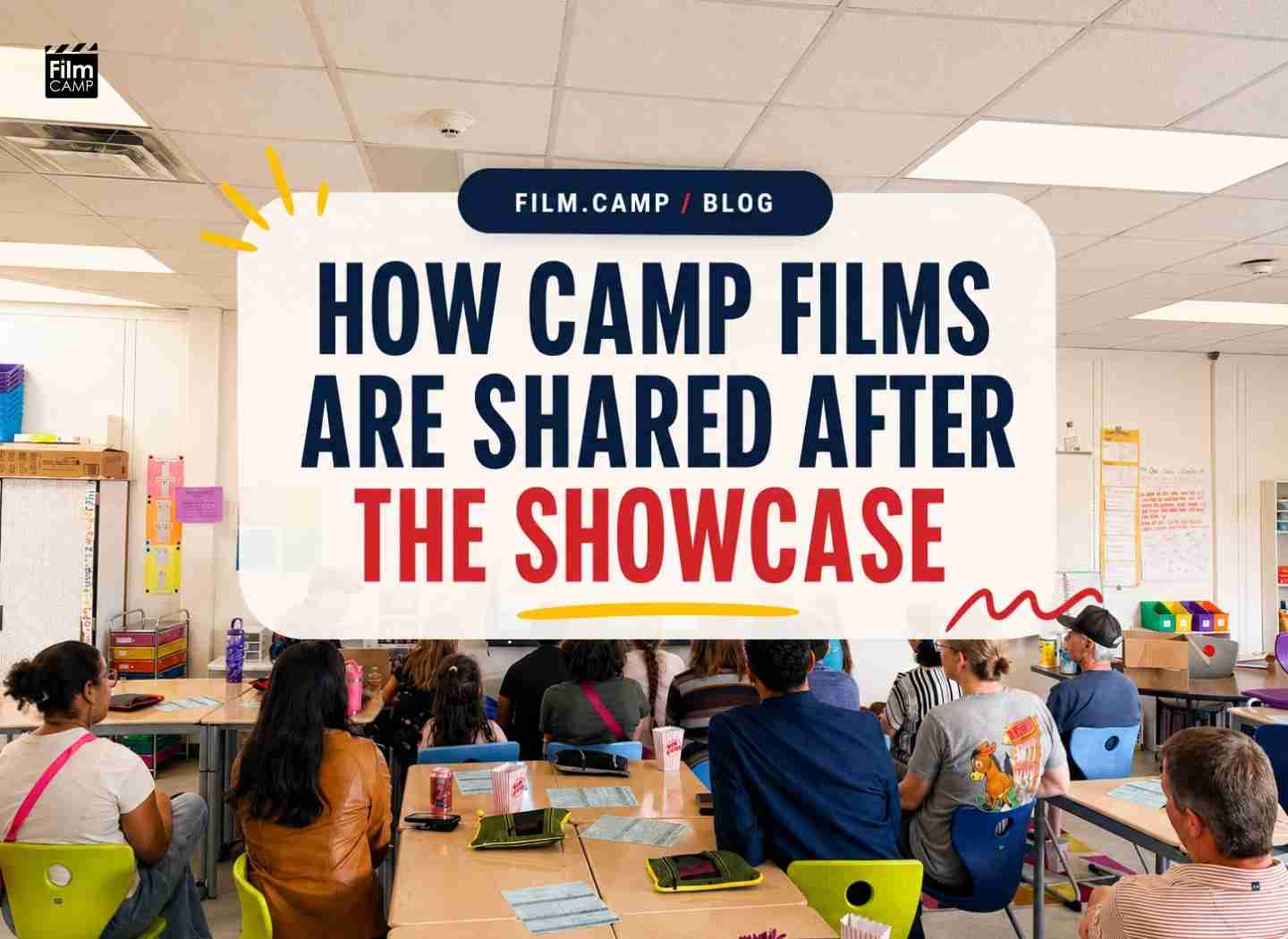
After the showcase, camp films reach families as private digital links within days. Learn how delivery works, how media consent protects privacy, and how to safely share your child's movie.
Read >.jpg)
Learn the key film shot types every young director should know. This guide explains wide shots, close-ups, angles, and camera moves in plain words, with easy home drills kids can try.
Read >
Everything parents need to know about San Francisco Film Camp, July 20–24: what kids ages 7–14 do each day, tuition, what to pack, and how to reserve a spot.
Read >.png)